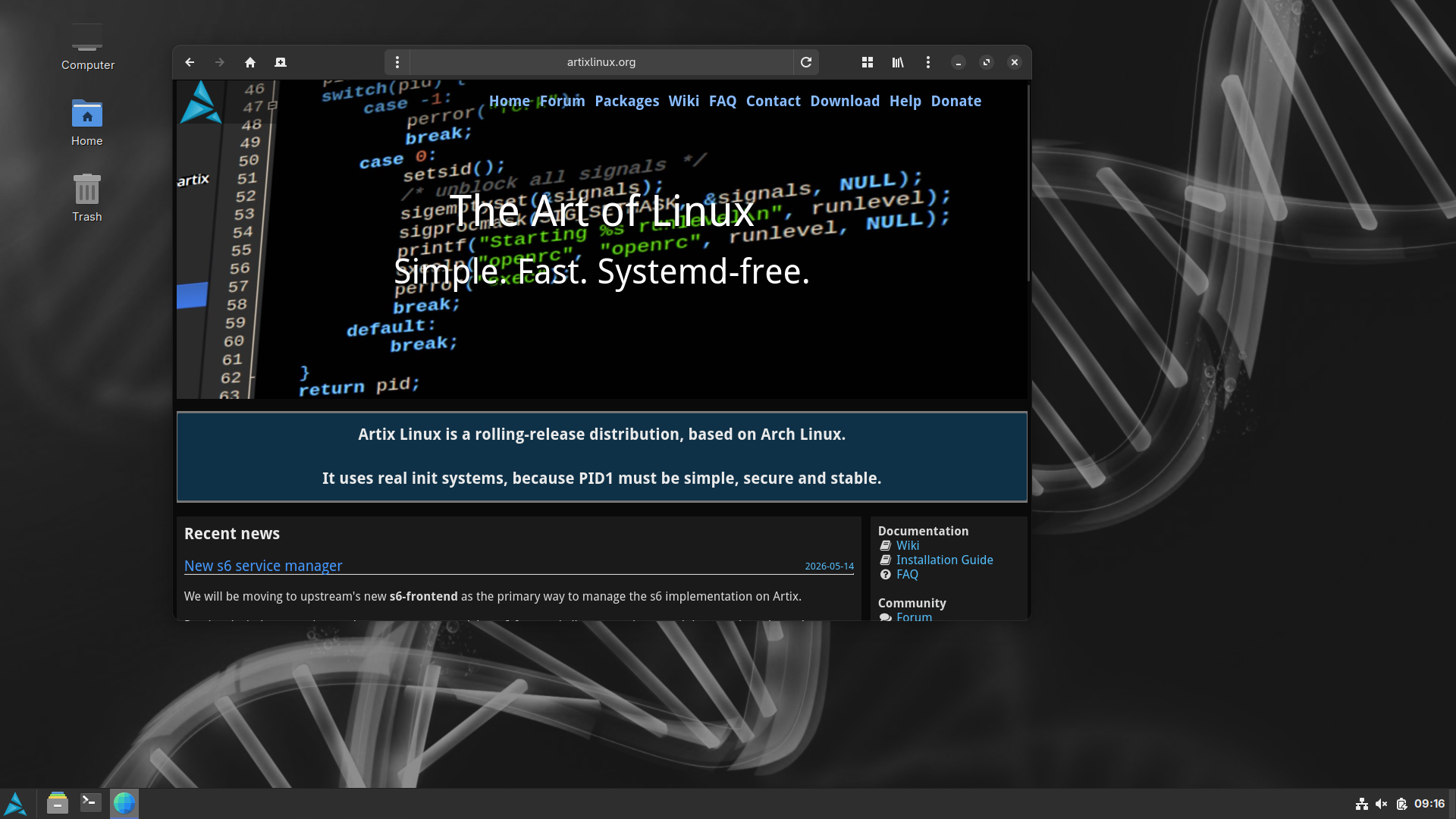
Artix Review
Artix Linux 20260813: Arch Power Without systemd
Artix Linux is a fork (or continuation as an autonomous project) of the Arch-OpenRC and Manjaro-OpenRC projects. According to DistroWatch, it offers a lightweight, rolling-release operating system featuring the OpenRC init software, with alternative spins built around runit and s6. The current release, Artix Linux 20260813, is dated August 14, 2026, and is available as a free ISO download. It is based on Arch, runs on x86_64, and comes in several editions: a plain command line or one of six desktop environments.
The pitch is right there in the name of the game: this is Arch for people who want nothing to do with systemd. If Arch itself is the do-it-yourself benchmark — see our Arch review for what the base brings — Artix keeps the rolling-release machinery and the pacman-powered software world while swapping out PID 1 for something simpler. DistroWatch lists it as a Desktop, Live Medium distribution with global origins, and the audience has noticed: it currently sits at rank 19 on DistroWatch with 508 hits per day, and visitors rate it 9.1 out of 10 across 256 reviews.
What follows is a tour of the 20260813 release: the init-system philosophy that defines the project, the unusually wide choice of editions, and the rolling Arch foundation underneath it all.
Artix Linux 20260813 at a Glance
| Feature | Artix Linux 20260813 |
|---|---|
| Release date | August 14, 2026 |
| Listed end of life | Not listed (rolling release) |
| Cost | Free download |
| Based on | Arch |
| Origin | Global |
| Installation method | Live medium; graphical desktop editions and a plain command-line edition |
| Default desktops | Cinnamon, LXDE, LXQt, MATE, KDE Plasma, Xfce |
| Package management | pacman |
| Release model | Rolling |
| Supported architecture | x86_64 |
| Init system | OpenRC (flagship); runit and s6 spins; latest release also lists dinit |
| Category | Desktop, Live Medium |
| DistroWatch popularity rank | 19 (508 hits per day) |
| DistroWatch visitor rating | 9.1/10 from 256 reviews |
Table note: The surrounding scrolling container is intentional. It prevents a wide table from breaking a mobile layout and lets visitors scroll horizontally when necessary.
Systemd-Free by Design, Init-Agnostic by Philosophy
The init system is the whole point of Artix. DistroWatch’s description puts OpenRC front and center as the featured init software, with runit and s6 available in alternative spins — and the release comparison table for 20260813 lists dinit alongside OpenRC as init options for the current release. Rather than treating the init as an implementation detail, Artix treats it as a choice the user should make, and it ships editions around each option.
That lineage is worth knowing: Artix continues the work of the Arch-OpenRC and Manjaro-OpenRC projects, which kept the Arch and Manjaro userlands running without systemd. If you are curious about the Manjaro side of that family tree, our Manjaro review covers what the Manjaro base contributes. On Artix, the practical upshot is a system where service management feels closer to classic Unix — small, explicit, and out of your way.
Six Desktops and a Command Line
Where many distributions ship one flagship desktop and call it a day, DistroWatch lists six for Artix: Cinnamon, LXDE, LXQt, MATE, KDE Plasma, and Xfce — plus a plain command-line edition for minimal installs and servers. That breadth is part of the lightweight pitch: pick the interface that matches your hardware and your taste, from the featherweight LXDE and LXQt up to a full KDE Plasma desktop, without carrying anything you did not ask for.
Free Credit Score Monitoring At Sofi
The Live Medium category means the graphical editions boot into a working desktop before you commit, so you can test-drive your chosen edition and init combination first. It is a sensible setup for a distribution whose whole identity is about giving the user control at every layer of the stack.
Rolling Release, Arch DNA
Underneath the init-system story, Artix is a rolling-release distribution based on Arch, and it behaves like one: there are no version upgrades to schedule and DistroWatch lists no end-of-life date. The 20260813 release is simply the current ISO snapshot, dated August 14, 2026, giving new installs a fresh starting point on the rolling stream. Package management runs through pacman — DistroWatch’s own Artix screenshot gallery even includes a shot of pacman doing its thing — so the software world is the familiar Arch one, minus systemd.
Artix is not the only project polishing the Arch rolling experience for desktop users. Our EndeavourOS review looks at another accessible take on Arch-based rolling, and our CachyOS review covers a performance-tuned branch of the same family. Artix stands apart in that company by making the init system — not the scheduler or the installer — its defining customization.
Who Should Try Artix?
- Arch users who want systemd out of PID 1 without giving up the Arch software ecosystem.
- Tinkerers who want to choose their init system — OpenRC, runit, s6, or dinit — instead of having it chosen for them.
- Minimalists who like a lightweight base and want to pick a desktop, or skip one entirely with the command-line edition.
- Rolling-release fans who prefer distributions that refresh their install media, like the 20260813 snapshot.
- Desktop hoppers deciding between six interfaces — Cinnamon, LXDE, LXQt, MATE, KDE Plasma, Xfce — on the same base.
- Curious Linux users who want to learn how a modern system runs without systemd.
Final Thoughts
Artix Linux 20260813 is a free, rolling, Arch-based distribution for x86_64 that replaces systemd with a choice of OpenRC, runit, s6, and dinit, offers six desktop editions plus a command-line build, and manages software with pacman. With a DistroWatch popularity rank of 19 and a 9.1/10 visitor rating across 256 reviews, it is one of the most respected niche distributions in the Linux world.
Bottom line: if you like everything about Arch except systemd, Artix Linux 20260813 is the most direct answer available — the same rolling DNA, your choice of init, and an edition for nearly every desktop taste.
Source: DistroWatch Artix Linux page, release 20260813, dated August 14, 2026.