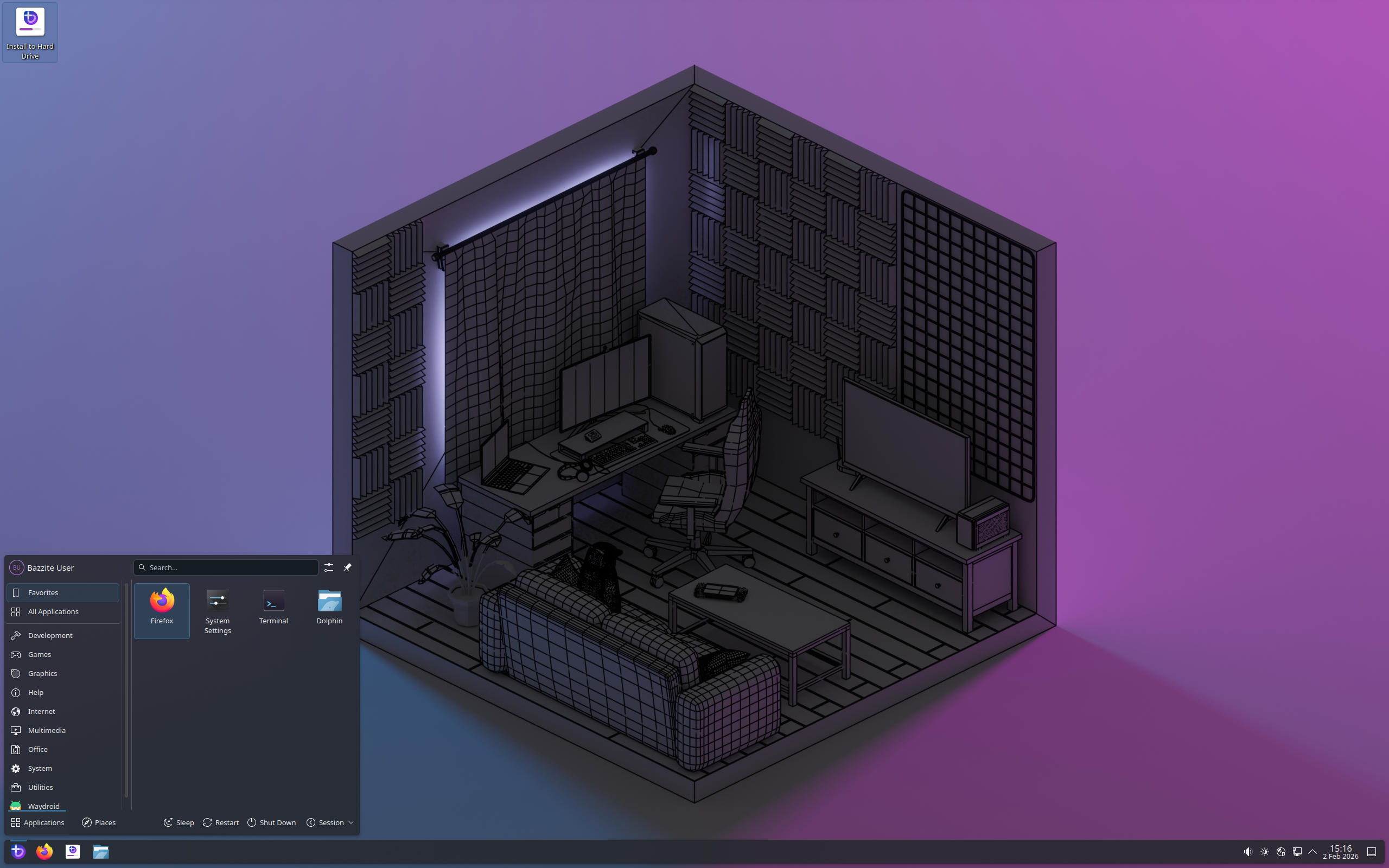
Bazzite Review
Bazzite 44: The Fedora-Based Immutable Distribution That Turns Linux Into a Gaming Console
Built on Fedora and designed for gaming, Bazzite pairs a read-only base system with Flatpak applications, runs on everything from the Steam Deck to the desktop, and its latest release — Bazzite 44 — brings KDE Plasma 6.6, GNOME 50, and a fresh gaming kernel. Here’s what the DistroWatch listing says about it.
According to its DistroWatch listing, Bazzite is “an immutable Linux distribution based on Fedora and designed with gaming in mind.” It runs on desktop computers, the Steam Deck, and other handheld gaming devices — a rare combination of targets for a single distribution. The base system is read-only, and packages are usually supplied using Flatpak bundles, which means the core OS stays pristine no matter what you install on top of it. It is available in GNOME and KDE Plasma desktop variants.
The release currently listed by DistroWatch is Bazzite 44, announced on April 29, 2026, based on Fedora 44. It sits at rank 11 on DistroWatch’s popularity chart over the past 12 months (about 796 hits per day), with an average visitor rating of 8.5 out of 10 from 60 reviews — one of the stronger ratings in the gaming category. Bazzite is free to download, with ISOs of roughly 6.3 GB (GNOME) and 7.2 GB (KDE Plasma). If you have already read our Fedora review, you will recognize the upstream foundation — Bazzite’s whole pitch is what Fedora becomes when it is tuned, hardened, and shipped for play.
At a Glance
| Feature | What Bazzite 44 Offers |
|---|---|
| Current listed release | Bazzite 44, announced April 29, 2026 (Fedora 44 base) |
| Distribution base | Fedora |
| Release model | Fixed |
| Default desktop | GNOME and KDE Plasma (separate variants) |
| Package management | Flatpak; flatpak and rpm package formats |
| Installer | Graphical |
| Default browser | Firefox |
| Kernel and graphics (Bazzite 44) | OGC Linux kernel 6.19.x; Mesa 26.0.5 |
| Supported architectures | x86_64 |
| Init system | systemd |
| Listed journaled file system | ext4 |
| Typical ISO size | Approximately 6,272 MB (GNOME) to 7,162 MB (KDE Plasma) |
| Multilingual | Yes |
| DistroWatch popularity | Rank 11 over 12 months (~796 hits per day) |
| Visitor rating | 8.5 out of 10 from 60 reviews |
| Price | Free |
Feature details and version information are based on the DistroWatch Bazzite listing for release 44.
Immutable by Design: A Read-Only Base That Survives Play
The word “immutable” does a lot of work in Bazzite’s description. Because the base system is read-only, the operating system cannot be accidentally modified by a bad install script, a broken driver, or an overenthusiastic tweak — the exact kind of damage a gaming machine, with its constant stream of driver and peripheral experiments, is prone to. Applications arrive as Flatpak bundles, sandboxed and self-contained, so your games and tools live in their own layer above an untouched core.
That design pairs well with the fixed release model DistroWatch lists: rather than rolling continuously, Bazzite moves in major releases tied to Fedora’s cadence, which keeps the gaming stack — kernel, Mesa, desktop — consistent and testable for months at a time. It is a fundamentally different philosophy from rolling gaming options such as CachyOS, another distribution that puts gaming first but does it with a rolling Arch base. Bazzite bets that gamers benefit more from a system that cannot drift than from the newest package the hour it lands.
Bazzite 44: KDE Plasma 6.6, GNOME 50, and a New Gaming Kernel
The Bazzite 44 release announcement, quoted by DistroWatch, calls this “the big one — new kernel, new versions of GNOME/KDE, and more.” The highlights are substantial: KDE Plasma 6.6 with the new Plasma Login Manager on the KDE variant, and GNOME 50 on the GNOME variant. Under the hood sits the OGC Linux kernel 6.19.x, with the 7.0 kernel — and Valve’s VRAM patchset — announced as coming in the near future, alongside Mesa 26.0.5 for graphics drivers.
Bazzite’s own tooling gets attention too. Bazaar 0.7.15, the project’s app store, ships in this release, while Ptyxis has been dropped from the KDE images in favor of the new Konsole terminal with container support. Security and supply-chain transparency are a theme: changelogs are now powered by SBOMs, builds carry attestation, OpenSSF security scanning is in place, and the ISO images are signed. The images themselves shrank by a full gigabyte, with in-image QEMU and ROCm moved to Bazzite-DX for users who actually need them. Niche hardware gets love as well — built-in support for Elgato 4K capture cards and the latest ASUS Linux patches for use with ASUSCtl — the kind of gamer-specific polish that generic Fedora never ships.
Handhelds, the Steam Deck, and the Big Screen
Most distributions pick a lane: desktop or portable. Bazzite deliberately refuses to choose. The DistroWatch description names desktop computers, the Steam Deck, and other handheld gaming devices as supported hardware, and the project’s release history shows that commitment is real — the Bazzite 43 release (October 29, 2025) added support for a wave of handhelds, including the Xbox Ally, Xbox Ally X, Legion Go 2, OneXPlayer X1 Air, and SuiPlay0X1, with details down to RGB lighting, fan curves, back buttons, and amplifier quirks worked out in collaboration with hardware vendors.
For a Steam Deck owner, that means the same distribution can power the Deck and the desktop beside it, with one update story and one software model. For a desktop gamer, it means hardware enablement that was battle-tested on handhelds — suspend/resume fixes, controller support, display oddities — comes along for free. The graphical installer and the large, multilingual ISO images keep the install approachable even for users whose only Linux experience is the Steam Deck’s desktop mode.
Software the Flatpak Way: Bazaar, Firefox, and Your Games
On an immutable system, how you install software matters more than usual — and Bazzite’s answer is Flatpak all the way down. The DistroWatch listing names flatpak as the package management method (with flatpak and rpm as the supported formats), which means most applications arrive as sandboxed bundles that cannot touch the read-only base. Bazaar, the project’s own store at version 0.7.15 in Bazzite 44, is the front door for that software, giving Flatpak a curated, gaming-friendly storefront instead of a bare package list.
The rest of the default stack is sensible and mainstream: Firefox as the default browser, systemd as the init system, ext4 as the journaled file system, and x86_64 as the single supported architecture — Bazzite knows exactly which hardware it serves and does not pretend otherwise. If you are coming from a traditional package-manager workflow, the Flatpak-first approach takes adjustment; unlike a distribution such as EndeavourOS, where pacman reaches the whole system, Bazzite keeps the base sealed and hands you a container-native workflow for everything else.
Who Should Try Bazzite?
Bazzite is a specialist distribution, but it fits its target users remarkably well:
- Steam Deck and handheld owners who want a full Linux distribution that treats portable gaming hardware as a first-class citizen — Xbox Ally, Legion Go, OneXPlayer, and more are explicitly supported.
- Desktop gamers who want a system that cannot be broken by tinkering — the read-only base and Flatpak software model mean a bad install cannot corrupt the OS.
- Linux gamers who value stability over bleeding edge — the fixed release model and Fedora base give you a tested kernel, Mesa, and desktop stack instead of daily churn.
- Streamers and content creators who can use the built-in Elgato 4K capture card support without hunting for drivers.
- ASUS hardware owners who benefit from the bundled ASUS Linux patches and ASUSCtl support.
Conversely, users who want the absolute newest packages the day they land, or who run ARM or 32-bit hardware, should look elsewhere — Bazzite is x86_64-only, fixed-release, and deliberate about it. And gamers who prefer a traditional mutable system with full pacman or apt control might find EndeavourOS more their speed. But if your priority is a gaming system that stays working, Bazzite’s immutability is a feature, not a limitation.
Final Thoughts
Bazzite 44 is a confident, focused release: Fedora-based, immutable, fixed-release, free, with KDE Plasma 6.6 and GNOME 50 variants, the OGC Linux 6.19 kernel, Mesa 26.0.5, signed images, SBOM-powered changelogs, and explicit support for the Steam Deck and a growing list of handhelds. The 8.5/10 visitor rating across 60 reviews suggests a community that found exactly what it was looking for.
Where our Manjaro review covers another gaming-friendly distribution with a very different (rolling, mutable) philosophy, Bazzite makes the opposite bet: seal the base, sandbox the apps, and let gamers game. For the Steam Deck owner who wants the same OS on their desktop, or the tinkerer who is tired of reinstalling after breaking things, that bet pays off.
Source: DistroWatch Bazzite page (https://distrowatch.com/table.php?distribution=bazzite). Information cited in this post reflects the DistroWatch listing and release information for Bazzite 44, announced April 29, 2026.