Mageia Review
Mageia 10: The Community-Built Mandriva Successor
Mageia has one of the most romantic origin stories in Linux. According to its DistroWatch listing, it is a fork of Mandriva Linux formed in September 2010 by former employees and contributors to the popular French distribution. Where Mandriva was a commercial entity, Mageia is a community project and a non-profit organisation with a simple goal: developing a free Linux-based operating system.
Sixteen years later, that community model is still going strong. Mageia 10 was released on 2026-06-29 per its DistroWatch listing, and the project holds a popularity rank of 29 (339 hits per day) with an average visitor rating of 8.5/10 across 138 reviews. If you read our Linux Mint review, you will recognise the same goal — a polished, welcoming desktop — except Mageia builds it from a fully independent base instead of riding on Ubuntu.
At a Glance
| Release | Mageia 10 (released 2026-06-29) |
|---|---|
| OS Type | Linux |
| Based On | Independent (fork of Mandriva Linux) |
| Origin | France |
| Architectures | aarch64, armv7, i686, x86_64 |
| Default Desktops | GNOME, KDE Plasma, Xfce |
| Installer | DrakX |
| Package Format | rpm, flatpak |
| Package Management | dnf, urpmi |
| Release Model | Fixed |
| Init System | systemd |
| Filesystems | Btrfs, ext4, JFS, ReiserFS, XFS |
| Default Browser | Firefox ESR |
| Office Suite | LibreOffice |
| Image Size | 3800–5500 MB |
| Price | Free |
| DistroWatch Popularity | Rank 29 (339 hits/day) |
| Visitor Rating | 8.5/10 from 138 reviews |
All facts from Mageia’s DistroWatch listing; release per the 2026-06-29 entry.
Fifteen Desktops, No Excuses
Mageia’s desktop menu is genuinely absurd — in the best way. The listing counts fifteen desktop environments and window managers: Awesome, Cinnamon, GNOME, Hyprland, i3, IceWM, KDE, MATE, labwc, LXDE, LXQt, Openbox, Sway, WMaker, and Xfce. The official spins default to GNOME, KDE Plasma, or Xfce, so most people will pick one of the big three and never look back — but if you are the kind of user who rotates between a tiling window manager and a full desktop depending on the machine, Mageia lets you do it without switching distributions.
Plasma fans get a particularly comfortable seat here: KDE is one of the headline default options, and if you want the absolute freshest Plasma instead of a stable snapshot, our KDE neon review covers the bleeding-edge alternative. Mageia’s appeal is the opposite trade: a well-tested, community-curated KDE that stays put for the release cycle.
Refinance Your Student Loan At Sofi
DrakX and the Mageia Control Center
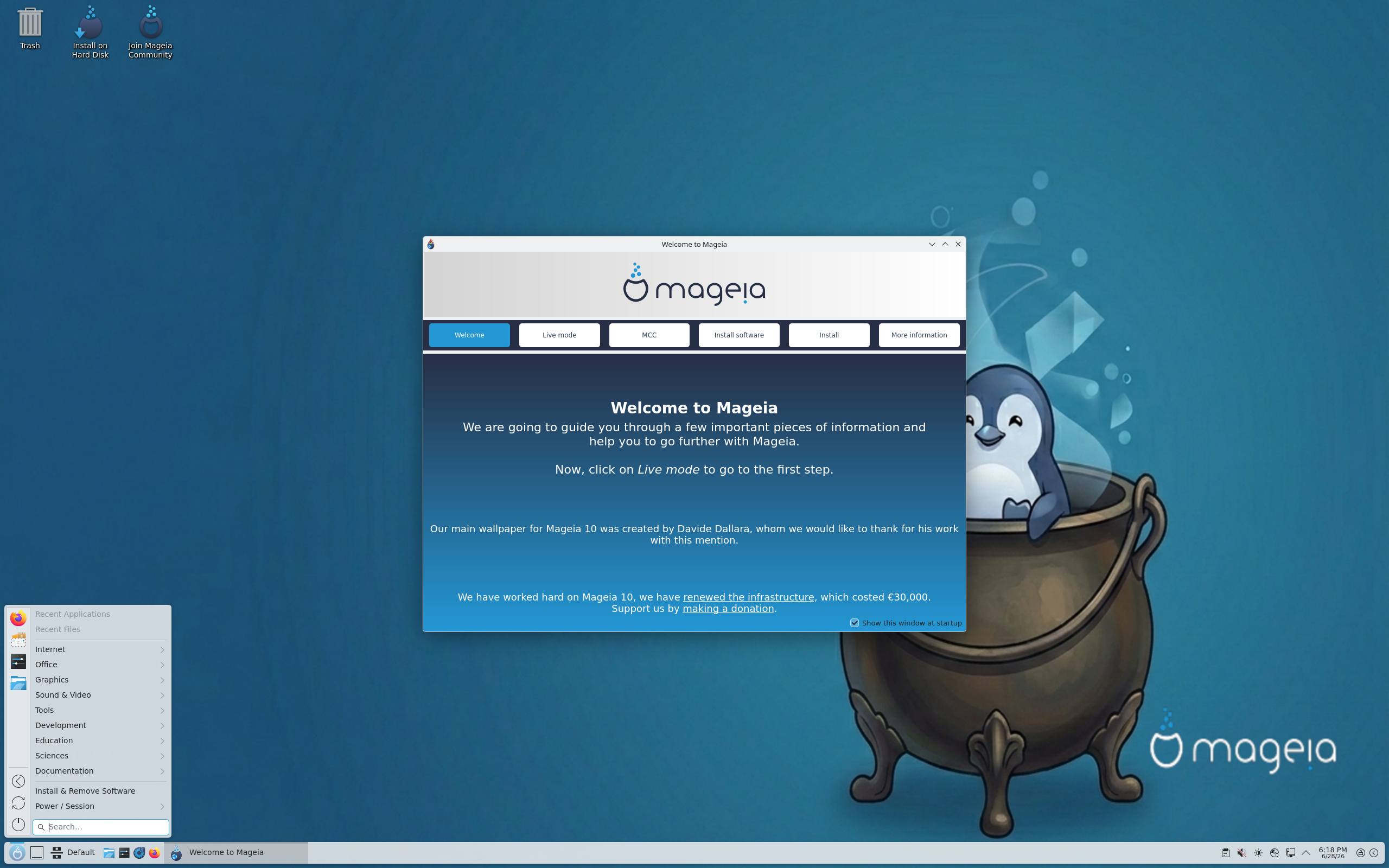
The Mandriva DNA shows in Mageia’s tooling. Installation is handled by DrakX, the classic Mandriva installer, and the first thing the live system shows you is a friendly “Welcome to Mageia” window — visible in the screenshot — with one-click shortcuts for live mode, installing, and the MCC, the Mageia Control Center. That control-center tradition is something commercial-era Mandriva was famous for: graphical tools that keep you out of the terminal for everyday administration.
It is a deliberate design philosophy, not nostalgia for its own sake. Mageia ships as a Live Medium as well as desktop and server images, so you can boot the welcome screen, try the system, and install only when it clicks — the same try-before-you-commit model that keeps newcomers from bouncing off.
Classic RPM, Modern Habits
Under the hood, Mageia is a classic RPM distribution with modern packaging habits. The listing records both dnf and urpmi for package management — urpmi is the old Mandriva tool, kept alongside the contemporary dnf — and the package format column shows rpm plus flatpak, so newer desktop applications can arrive in the sandboxed format while the system stays on RPMs.
The rest of the stack is reassuringly standard: systemd as init, a wide journaled-filesystem menu (Btrfs, ext4, JFS, ReiserFS, XFS), Firefox ESR as the default browser, and LibreOffice in the suite slot. If you like the idea of an RPM-based, fixed-release distro with KDE chops but want the enterprise-backed flavor, our openSUSE review is the natural comparison — Mageia is the community-governed mirror image of that same idea.
Fixed Releases, Rolling Cauldron
Mageia 10 follows a fixed release model — one polished release, then point-stability until the next one — which suits its server category as well as the desktop. But DistroWatch’s comparison table also lists a rolling “cauldron” development branch running alongside the fixed versions. That is where the next release simmers before it is declared ready, and adventurous users can tap into it to see where the project is headed.
It is a fitting arrangement for a project that has survived entirely on volunteer energy since 2010: the stable release for people who just want it to work, and a rolling cauldron for the tinkerers who keep the community alive.
Who Should Try Mageia?
- Mandriva nostalgics: The community continuation of a beloved French distro — DrakX, urpmi, and the control-center philosophy intact.
- Community-project supporters: A non-profit, volunteer-governed project with a sixteen-year track record and an 8.5/10 DistroWatch rating.
- Desktop hoppers: Fifteen environments from KDE Plasma and GNOME down to Sway and Window Maker, without changing distributions.
- RPM users who want stability: A fixed release cycle on dnf/urpmi with flatpak support — enterprise-style predictability without a corporate parent.
- Live-USB explorers: Boot the live medium, try the welcome screen and the MCC, install with DrakX only if it wins you over.
Final Thoughts
Mageia 10 is the rare independent distribution that feels finished rather than scrappy: a clear origin story, a non-profit community behind it, classic Mandriva tooling wrapped in a welcoming first-boot experience, and fifteen desktops to choose from. It will never win the speed-obsessed benchmarks that make our CachyOS review exciting, but that was never its job. Mageia’s job is to be the community desktop that simply works — and after sixteen years of doing exactly that, it has earned its 8.5/10.
Source: Mageia’s DistroWatch listing (https://distrowatch.com/table.php?distribution=mageia), release Mageia 10, 2026-06-29.