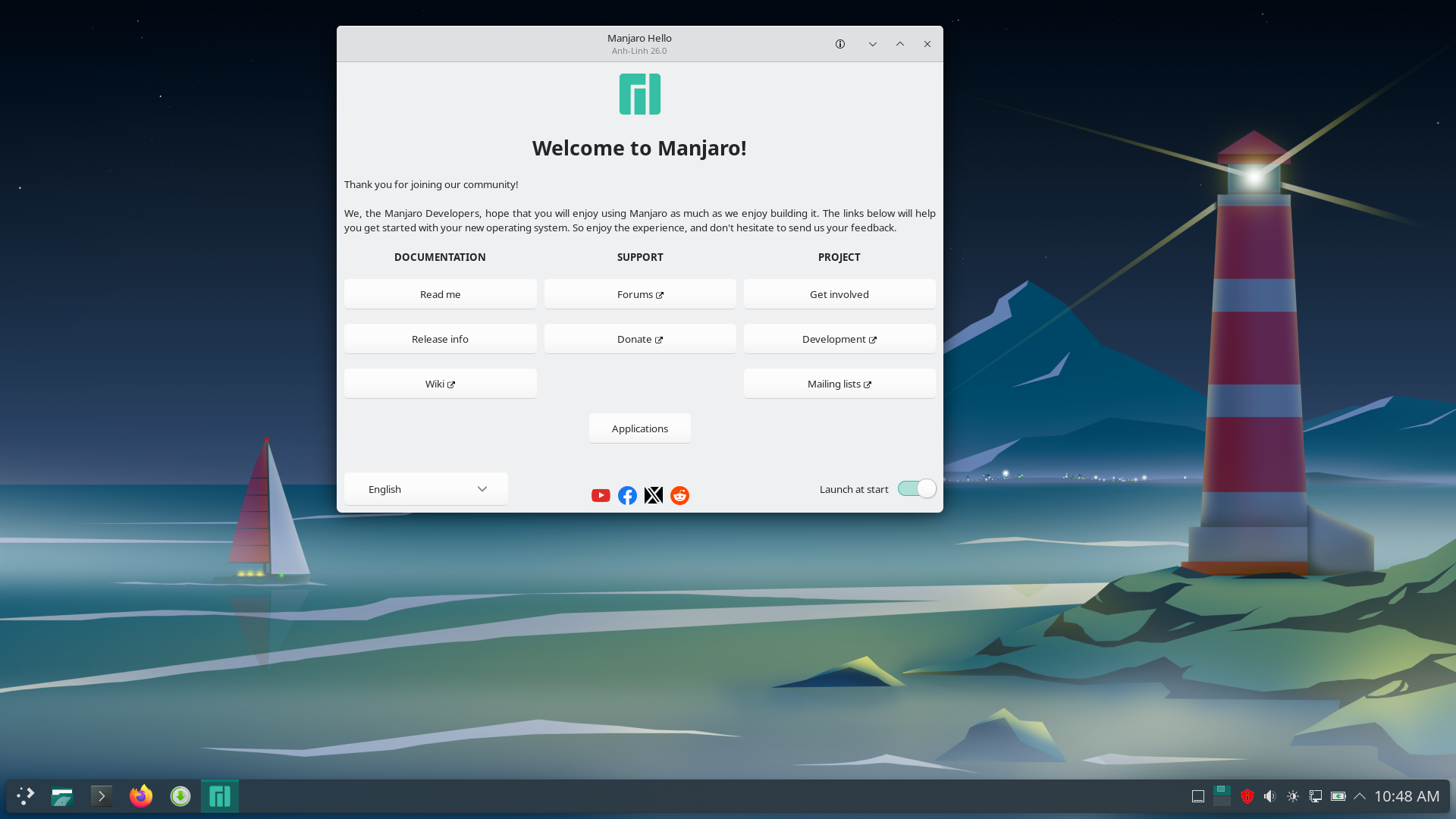
Manjaro Review
Manjaro 26.0.4: The Arch-Based Rolling Release Built for Everyday Desktops
Arch Linux underneath, a stable rolling-release model on top, three polished desktop editions, and hardware handling that works out of the box. Here is what the DistroWatch listing says about the current Manjaro release.
If Arch Linux has a reputation for being powerful but demanding, Manjaro exists to change the second half of that sentence. According to its DistroWatch listing, Manjaro is “a fast, user-friendly, desktop-oriented operating system based on Arch Linux,” and its key features read like a checklist of Arch’s friction points: an intuitive installation process, automatic hardware detection, a stable rolling-release model, the ability to install multiple kernels, special Bash scripts for managing graphics drivers, and extensive desktop configurability.
The release currently listed by DistroWatch is Manjaro 26.0.4, released March 27, 2026, following the 26.0 announcement of January 4, 2026. It is a rolling-release distribution, free to download as an ISO (roughly 3.1 to 4.3 GB depending on the edition), built for x86_64 systems — with aarch64 builds also listed, and DistroWatch filing the project under the Raspberry Pi category too. It sits at rank 9 on DistroWatch’s popularity chart (about 1,032 hits per day), with an average visitor rating of 8.3 out of 10 from 502 reviews — one of the stronger ratings in the top ten.
Readers of our EndeavourOS review will recognize the same starting point — Arch underneath, friendliness on top — but Manjaro takes the curated route where EndeavourOS stays close to vanilla Arch: its own tested repositories, a desktop-first polish, and tooling that assumes you would rather use the system than assemble it.
At a Glance
| Feature | What Manjaro 26.0.4 Offers |
|---|---|
| Current listed release | Manjaro 26.0.4, released March 27, 2026 (26.0 announced January 4, 2026) |
| Distribution base | Arch Linux |
| Origin | Austria, France, Germany |
| Release model | Rolling release, described as a “stable rolling-release model” |
| Official desktop editions | Xfce (the core desktop), KDE Plasma, GNOME; community flavours add Cinnamon, i3, labwc, MATE, and Sway |
| Package management | pacman; pkg, Flatpak, and Snap package formats |
| Installer | Graphical |
| Default browser | Firefox |
| Included office suite | OnlyOffice |
| Supported architectures | x86_64, aarch64 (also filed under the Raspberry Pi category) |
| Init system | systemd |
| Listed journaled file systems | Btrfs, ext4, JFS, XFS |
| Typical ISO size | Approximately 3.1 to 4.3 GB |
| Multilingual | German, English, French |
| Price | Free |
Feature details and version information are based on the DistroWatch Manjaro listing for release 26.0.4.
Rolling Release With a Safety Net
The defining idea is right there in the listing’s description: a “stable rolling-release model.” DistroWatch lists Manjaro’s release model simply as Rolling — no version numbers to chase, no reinstall every couple of years — but the project’s own framing emphasizes stability: updates flow continuously, curated through Manjaro’s own tested repositories rather than landing raw. It is Arch’s always-current philosophy with a layer of judgment between upstream and your desktop.
That distinction is worth understanding if you are weighing Arch-based options. CachyOS rides the same Arch rolling model but aims at performance tuning for enthusiasts who like to tweak; Omarchy commits the rolling base to one opinionated developer workflow. Manjaro’s bet is the broad middle: rolling and current, but paced for people who want their desktop to simply work the morning after an update.
Three Official Editions, Eight Desktops in All
The listing names Xfce as the core desktop, with KDE and GNOME as the other official editions — the 26.0.4 feature table lists GNOME, KDE Plasma, and Xfce as the default desktops. Then the community flavours extend the menu: Cinnamon, i3, labwc, MATE, and Sway, plus a minimalist Net edition for advanced users who want to build up from nearly nothing. Eight ways to experience the same rolling base, from a lightweight tiling setup to a full traditional desktop.
That breadth is a quiet differentiator among Arch derivatives. Where some projects pick one desktop and tune it relentlessly, Manjaro treats the desktop as a genuine choice — and the DistroWatch description lists “extensive desktop configurability” as a headline feature, which suggests the editions are meant to be shaped, not merely selected.
Pacman Underneath, Every Package Format on Top
Software management starts with pacman, Arch’s famously fast package manager, and the pkg format it serves. But the listing’s package-format row adds Flatpak and Snap to the mix — so a Manjaro user gets the rolling Arch repositories for system software and the two universal formats for everything else. The DistroWatch screenshot gallery even shows the Pamac graphical package manager in action, which fits the project’s user-friendly brief: pacman power without mandatory terminal fluency.
The trade is the usual Arch one, made friendlier. Software stays current because the release model is rolling, and you never face a distribution upgrade — you just update. Firefox is the listed default browser and OnlyOffice the listed office suite for 26.0.4, so a fresh install arrives with the working-day basics already covered.
Hardware That Detects Itself, Kernels You Can Swap
Two of the listing’s headline features speak directly to real machines: automatic hardware detection, and special Bash scripts for managing graphics drivers. The graphical installer walks through setup, and once installed, the system is meant to sort out drivers — including the proprietary-versus-open graphics driver question that trips up newcomers on other Arch-based systems — without a wiki deep-dive.
Then there is the multiple-kernels feature, which the description calls out explicitly. On most distributions the kernel is something you live with; Manjaro treats it as a choice you can keep several of, switching between them if a newer kernel misbehaves with your hardware. Combined with the aarch64 builds and the Raspberry Pi category on the listing, the picture is a distribution that takes hardware seriously — from a gaming desktop’s GPU to a Pi on a shelf.
Who Should Try Manjaro?
Manjaro is the Arch on-ramp that keeps its training wheels optional:
- Arch-curious users who want the rolling-release model and pacman without installing Arch the manual way first.
- Desktop-first users who like current software but prefer updates curated through tested repositories rather than arriving raw from upstream.
- KDE Plasma, GNOME, or Xfce fans who want those desktops as official editions on a rolling base, with five more community flavours to explore.
- Tinkerers who will actually use the multiple-kernel support, the graphics-driver scripts, and the extensive desktop configurability the listing highlights.
- ARM and Raspberry Pi experimenters — the listing covers aarch64 and files Manjaro under the Raspberry Pi category.
Conversely, anyone who wants a fixed release with long support windows and version numbers that sit still should look at a fixed-release distribution like Linux Mint instead — Manjaro never stops moving, by design.
Final Thoughts
Manjaro 26.0.4 is Arch Linux with the sharp edges filed down: a stable rolling-release model, pacman plus Flatpak and Snap, a graphical installer, automatic hardware detection, swappable kernels, and eight desktop flavours led by Xfce, KDE Plasma, and GNOME. The 8.3/10 visitor rating across 502 reviews — and a 12-month popularity ranking holding at number 9 — suggest a large user base that found exactly the balance it was looking for.
If Arch’s rolling model appeals to you but the do-it-yourself installation and raw updates do not, Manjaro is the version of Arch built for actually living with. Start with the Xfce edition the listing calls the core desktop, and you will see why this distribution has stayed in DistroWatch’s top ten.
Source: DistroWatch Manjaro page (https://distrowatch.com/table.php?distribution=manjaro). Information cited in this post reflects the DistroWatch listing and release information for Manjaro 26.0.4, released March 27, 2026.