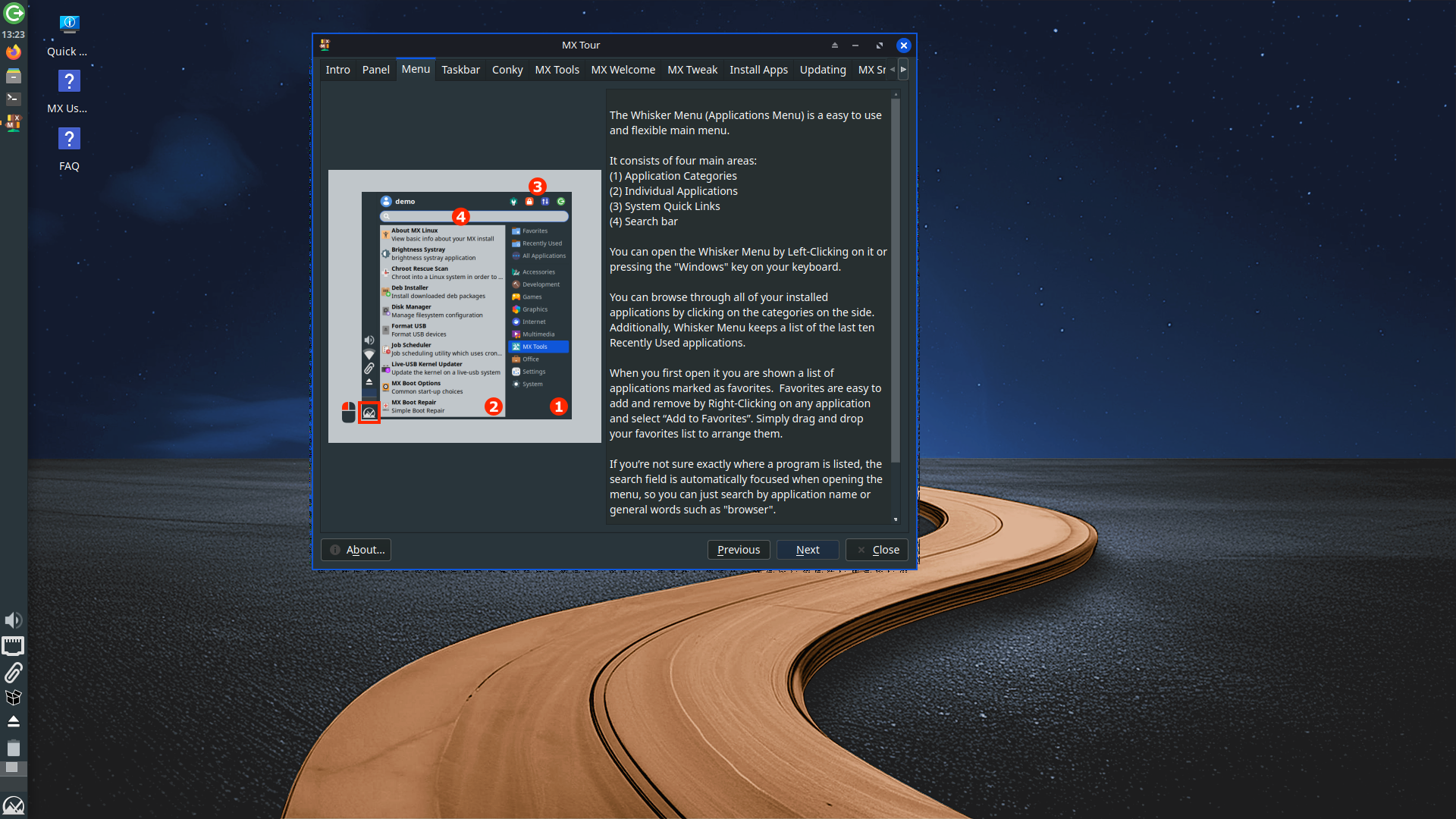
MX Linux Review
MX Linux 25.2 “Infinity”: A Debian-Stable Desktop With a Community Heart
Looking for a Linux desktop that pairs Debian’s rock-solid stability with a welcoming, mid-weight experience? MX Linux has held a top-three spot on DistroWatch for years, and its latest release keeps refining a formula shaped by one of Linux’s most helpful communities.
MX Linux is a desktop-oriented Linux distribution based on Debian’s “Stable” branch, and it is a cooperative venture between the antiX and former MEPIS Linux communities. Using Xfce as the default desktop, with separate KDE Plasma and Fluxbox editions also available, it is a mid-weight operating system designed to combine an elegant and efficient desktop with simple configuration, high stability, solid performance and a medium-sized footprint. On DistroWatch it currently ranks third at about 1,923 hits per day, and visitors rate it 8.1 out of 10 based on 821 reviews.
The latest release listed is MX Linux 25.2 “infinity”, released on May 24, 2026. It is free to download as an ISO image (roughly 2.2 GB to 3.4 GB depending on the edition), installs with the project’s own MX Installer, ships with Firefox as the default browser and LibreOffice as the office suite, and uses apt with deb and Flatpak package formats. It follows a semi-rolling release model on 64-bit x86 systems, with armhf builds also listed, and it supports both systemd and SysV init.
[adcmdr_ad id=”137″]
At a Glance
| Detail | MX Linux 25.2 “infinity” |
|---|---|
| Release date | May 24, 2026 |
| Based on | Debian (Stable) and antiX |
| Origin | Greece, USA |
| Desktops | Xfce by default; KDE Plasma and Fluxbox editions also available |
| Installer | MX Installer |
| Package formats | deb and Flatpak, managed with apt |
| Release model | Semi-rolling |
| Architecture | x86_64 (armhf builds also listed) |
| Init system | systemd or SysV |
| Journaled filesystems | Btrfs, ext4, JFS, XFS |
| Office suite | LibreOffice |
| Languages | English, Catalan, Czech, German, Spanish, French, Hungarian, Dutch, Brazilian Portuguese |
| Cost | Free |
| DistroWatch popularity | #3, about 1,923 hits per day |
| Visitor rating | 8.1/10 from 821 reviews |
Details above are based on the DistroWatch MX Linux listing for release 25.2 “infinity”.
A Community Project Built on Debian Stable
Few distributions wear their community roots as openly as MX Linux. It began as a cooperative venture between the antiX and former MEPIS Linux communities, and that collaborative character still defines it. DistroWatch lists its origin as Greece and the USA, and its forums and documentation pages are among the most active in the desktop Linux world.
Try YouTube TV | Special Discount
The foundation is Debian’s “Stable” branch, blended with antiX technology. That combination is deliberate: Debian Stable brings long-tested packages and security support, while the MX layer adds the configuration tools and desktop polish that make the system approachable out of the box. For users, the practical result is a system that rarely surprises you — updates arrive steadily, and the base underneath them changes at Debian’s careful pace.
Three Desktops: Xfce, KDE Plasma, and Fluxbox
MX Linux’s default desktop is Xfce, a long-standing favorite for users who want a complete, configurable desktop without heavy resource demands. But the project does not force one workflow on everyone: separate KDE Plasma and Fluxbox editions are also available.
This three-edition approach maps neatly onto the categories DistroWatch assigns to MX Linux, which include Old Computers and Raspberry Pi. The Xfce edition is the balanced middle ground, the Fluxbox edition trims the footprint further for modest hardware, and the KDE Plasma edition brings the full-featured modern desktop for more capable machines. One distribution, three temperaments — and the semi-rolling model keeps all of them current in the same way.
Refinance Your Student Loan At Sofi
[adcmdr_ad id=”135″]
Semi-Rolling Updates on a Stable Foundation
MX Linux describes its release model as semi-rolling. In practice, that means the system receives continuing updates to applications and desktop components without forcing a full reinstall or a disruptive version jump, while the Debian Stable core underneath keeps the ground from shifting.
The release history on DistroWatch shows this cadence in action: point releases like 25.1, 25, 23.6, and 23.5 arrive regularly, each one a refreshed snapshot users can install fresh or update into. It is a middle path between the “install once and wait two years” fixed-release rhythm and the constant churn of a pure rolling distribution — new enough to stay useful, stable enough to trust on a daily driver.
A Live Medium That Runs Almost Anywhere
DistroWatch also lists MX Linux under the Live Medium and From RAM categories, which speaks to how flexible the ISO is. You can boot it directly from a USB drive, try the full desktop without touching your hard drive, and — on machines with enough memory — run the whole system from RAM for a remarkably responsive test drive.
When you are ready to commit, the MX Installer handles the installation, and the ISO sizes (2.2 GB to 3.4 GB) reflect the complete, ready-to-use system inside: Firefox for browsing, LibreOffice for documents, and the usual suite of desktop tools. Few distributions make the journey from “let me try this” to “this is my system” as short.
Who Should Try MX Linux?
- Debian admirers who want Debian Stable’s reliability with a friendlier desktop and configuration experience.
- Owners of older computers who need a modern-feeling Linux desktop that respects modest hardware.
- Desktop choosers who like picking between Xfce’s efficiency, KDE Plasma’s power, and Fluxbox’s minimalism.
- Init-system traditionalists and modernists alike — both systemd and SysV are supported.
- Try-before-you-install users who appreciate a live medium that can run entirely from RAM.
- Multilingual households, with nine languages listed including Spanish, French, German, and Brazilian Portuguese.
Final Thoughts
MX Linux 25.2 “infinity” represents the distribution’s core strengths: it is free, built on Debian Stable, straightforward to install, and adaptable to everything from aging laptops to modern workstations. With three desktop editions, deb and Flatpak software, LibreOffice included, a semi-rolling update model, and a community that keeps it ranked third on DistroWatch with an 8.1/10 visitor rating, it remains one of the most practical Linux desktops you can download.
Bottom line: MX Linux is proof that stability and friendliness are not opposites. It takes Debian’s dependable foundation, adds thoughtful tools and genuine choice, and wraps it in a community that has kept it near the top of the DistroWatch charts for years.
[adcmdr_ad id=”133″]
Source: DistroWatch: MX Linux feature and package table. Information cited in this post reflects the DistroWatch listing for MX Linux release 25.2 “infinity”, released May 24, 2026.