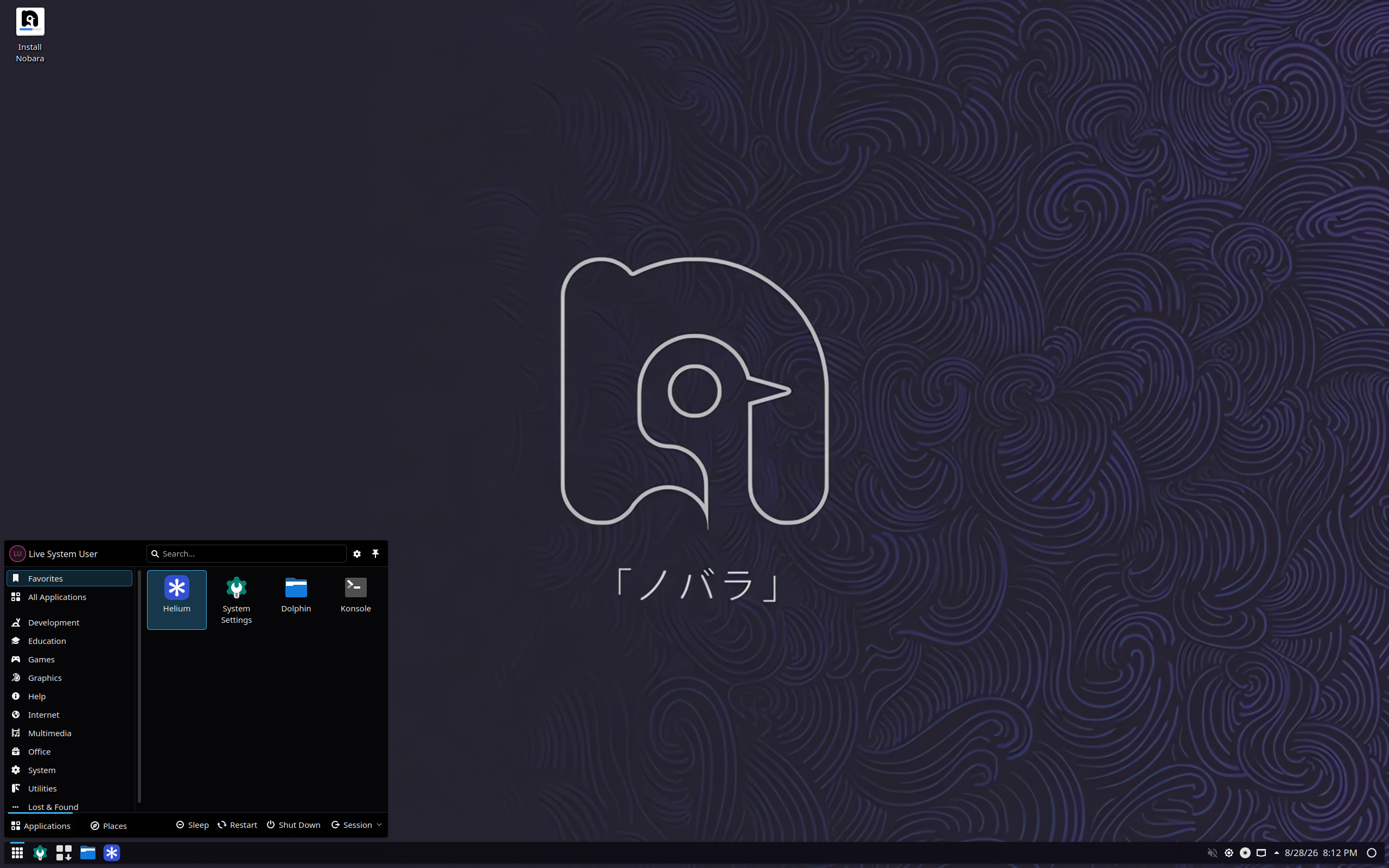
Nobara Review
Nobara Project 43: Fedora, Tuned for Gaming, Streaming, and Content Creation
Most gaming-oriented Linux distributions ask you to pick your poison: a rock-solid base with stale drivers, or bleeding-edge packages that need constant babysitting. Nobara Project tries to take that tradeoff off the table. It starts with Fedora Linux — the same foundation covered in our Fedora review — and layers on the drivers, codecs, and creative tools that usually take a fresh install an evening of forum threads to assemble.
According to its DistroWatch listing, Nobara Project is “a modified version of Fedora Linux with user-friendly fixes added to it.” Those fixes are precisely the things a new Linux user typically has to hunt down themselves: WINE dependencies, OBS Studio, third-party codec packages for GStreamer, NVIDIA drivers, and assorted package fixes. They all ship out of the box here, which is why the listing’s category line reads “Desktop, Gaming, Live Medium” instead of just “Desktop.”
The current listed release is Nobara Project 43, released on December 27, 2025. It is listed as a rolling release with a graphical installer, available as a free ISO download for x86_64 systems.
At a Glance
| Feature | What Nobara Offers |
|---|---|
| Distribution family | Fedora-based Linux distribution |
| Current listed release | 43, released December 27, 2025 |
| Release model | Rolling release (as listed for releases 42 and 43) |
| Desktop choices | Custom-themed GNOME (official release), plus separate standard GNOME and KDE Plasma editions |
| Installer | Graphical installation |
| Package format | RPM |
| Default browser | Brave |
| Office suite | LibreOffice |
| Supported architecture | x86_64 |
| Init system | systemd |
| Filesystems listed | Btrfs and ext4 |
| Price | Free |
| DistroWatch popularity | Rank 15 (about 650 hits per day) |
Feature details and version information are based on the DistroWatch Nobara Project listing for release 43.
Fedora as a Foundation, With the Rough Edges Filed Down
Nobara’s description on DistroWatch is refreshingly blunt: it exists to fix the things that don’t work quite right on a stock Fedora install for its target audience. Fedora itself is a fast-moving, well-engineered distribution — as our Fedora review notes — but its strictly free-software defaults mean that proprietary NVIDIA drivers, media codecs, and gaming libraries are left for the user to add. Nobara assumes you’d rather skip that part.
The result is a system where the underlying plumbing is familiar to anyone who has run a Fedora-family distribution — RPM packages, systemd, a graphical installer — but the post-install checklist is already done. That makes Nobara a middle path: more turnkey than upstream Fedora, but still closer to a conventional desktop distribution than an immutable, image-based gaming system like the one in our Bazzite review.
A Gaming and Streaming Kit That Works on Day One
This is the section Nobara is really selling. The DistroWatch summary calls out WINE dependencies for Windows game compatibility, OBS Studio for streaming and recording, third-party GStreamer codecs for media playback, and NVIDIA drivers for the large share of gaming PCs that carry GeForce cards. Each of those is individually easy to install; together, they represent the classic evening of setup that Nobara eliminates.
The release-43 package table backs up the gaming-first positioning. It lists Linux kernel 6.18.2, Mesa 25.3.2, and the NVIDIA 580.119.02 driver — recent graphics-stack components for a distribution released in December 2025. For context, other gaming-focused options on this site include our PikaOS review and our Manjaro review, but Nobara is the one that keeps a mainstream Fedora-style system underneath instead of rebuilding the platform around gaming.
Get An Easy Personal Loan At Sofi
The content-creation angle is worth noting too: with OBS Studio preinstalled alongside LibreOffice and multilingual support, the distro is aimed at people who produce video or streams, not just play games.
Three Editions: Custom GNOME, Standard GNOME, or KDE Plasma
Unlike distributions that commit to a single desktop, Nobara ships three editions. The project’s official release carries a custom-themed GNOME desktop, while separate editions offer a standard GNOME experience and KDE Plasma for users who prefer it. The release-43 package versions behind those desktops are GNOME Shell 49.2 and KDE Plasma Desktop 6.5.4, per the DistroWatch package table.
That choice matters for hardware as well as taste. GNOME remains the default recommendation, but KDE Plasma’s configurability and lower idle resource footprint make the Plasma edition a sensible alternative for mid-range gaming PCs. And with Btrfs and ext4 both listed as supported journaled filesystems, users can choose between snapshot-oriented storage management and the familiar ext4 default.
A Rolling Path Forward
One of the more interesting details in the listing is the release model: DistroWatch lists releases 42 and 43 as rolling, while release 41 and earlier were fixed. In practice, that means Nobara has moved away from the big point-release upgrades of its past toward a continuously updated model — a natural fit for a gaming distribution, where kernels, Mesa, and graphics drivers age fast.
The tradeoff is the usual one with rolling releases: the system stays current, but it rewards regular updates and occasional attention to project announcements. For a desktop whose whole purpose is staying ready for the latest games and streams, that is a reasonable bargain.
Who Should Try Nobara?
- Linux gamers who want WINE dependencies, current graphics drivers, and media codecs working immediately after install.
- Streamers and content creators who need OBS Studio and a Fedora-based system ready for video work out of the box.
- Fedora fans who like the Fedora ecosystem and RPM packaging but don’t want to spend an evening bolting on proprietary drivers and codecs.
- NVIDIA GPU owners — the NVIDIA driver ships preinstalled rather than requiring a post-install setup dance.
- Windows switchers looking for a familiar-feeling GNOME or KDE desktop with a graphical installer and no terminal-required setup.
Final Thoughts
Nobara Project occupies a practical niche: it is Fedora for people who game and create. Rather than asking users to master driver installation, codec hunting, and streaming-software setup, it ships those pieces working and lets the Fedora base — RPM packages, systemd, a graphical installer, and now a rolling update model — handle the rest. With three desktop editions, a free ISO, and a DistroWatch popularity rank of 15, it has clearly found its audience.
Bottom line: if you like the idea of Fedora but would rather spend your first evening gaming or streaming than configuring drivers, Nobara is worth a test drive.
Source: DistroWatch Nobara Project feature and package table, release 43, dated December 27, 2025.