openSUSE Review
openSUSE Tumbleweed: Two Release Models, Eleven Desktops, and Snapshots You Can Roll Back
One of the oldest names in Linux, openSUSE is an independent, community-run distribution sponsored by SUSE, shipping in two flavors: rolling Tumbleweed snapshots and fixed Leap releases built on SUSE Linux Enterprise. DistroWatch’s latest listed snapshot is dated June 17, 2026, Leap 16.0 arrived October 1, 2025, and the project holds rank 14 at 669 hits per day. Here’s what the DistroWatch listing says.
According to its DistroWatch listing, “The openSUSE project is a community program sponsored by SUSE Linux and other companies. Promoting the use of Linux everywhere, this program provides free, easy access to openSUSE, a complete Linux distribution.” The listing files it as an independent distribution from Germany with active status, and every listed release is free. That independence matters: unlike most big-name distributions, openSUSE answers to no upstream parent — it is the upstream, feeding SUSE Linux Enterprise rather than descending from it.
Like Fedora, openSUSE is RPM-based and enterprise-adjacent — Leap shares DNA with SUSE Linux Enterprise the way Fedora relates to RHEL. But openSUSE’s signature trick is structural: it ships as two distributions under one name. Tumbleweed is the rolling edition, with new snapshots published several times a week — each one held back until it passes the project’s automated openQA test suite. Leap is the fixed-release edition for users who want the ground to stay still. DistroWatch tracks both on a single page, which is why the release table runs from a Tumbleweed snapshot dated June 17, 2026, all the way back through Leap 16.0 (October 1, 2025) to the SUSE Linux days of the late 1990s.
At a Glance
| Feature | What openSUSE Offers |
|---|---|
| Current listed releases | Tumbleweed snapshot dated June 17, 2026 (rolling); Leap 16.0 released October 1, 2025 (fixed) |
| Distribution base | Independent |
| Release model | Rolling (Tumbleweed) and fixed (Leap) |
| Default desktops | KDE Plasma, GNOME, Xfce — plus Cinnamon, Enlightenment, IceWM, LXDE, LXQt, MATE, labwc, Wayfire |
| Package management | Zypper (command line) and YaST (graphical); RPM packages |
| Installer | YaST installer (Agama on Leap 16.0) |
| Init system | systemd |
| Listed journaled file systems | Btrfs, ext4, XFS |
| Supported architectures | aarch64, armhf, i686, ppc64, ppc64el, s390x, x86_64 |
| Multilingual | Yes |
| DistroWatch popularity | Rank 14 (~669 hits per day) |
| Reader reviews | 536 reader reviews on DistroWatch |
| Price | Free |
Feature details and version information are based on the DistroWatch openSUSE listing.
Two Flavors, One Project: Tumbleweed Rolls While Leap Holds Still
Most distributions ask you to choose a philosophy before you choose the distro: rolling or fixed, fresh or stable. openSUSE declines the question. Tumbleweed is a genuine rolling release — the listing’s latest entry is simply a snapshot dated June 17, 2026 — but it rolls with guardrails: every snapshot must pass the openQA automated test suite before it reaches mirrors, which is why Tumbleweed has a reputation as the rolling release for people who have been burned by rolling releases. Readers of our CachyOS review will recognize the appeal of always-current software; Tumbleweed is the veteran, belt-and-suspenders answer to the same itch.
Leap plays the opposite game. Leap 16.0, released October 1, 2025, is a fixed release built on SUSE Linux Enterprise 16 sources, with DistroWatch listing its end of life in 2032. That enterprise lineage is the point: where Tumbleweed chases the newest KDE Plasma or GNOME days after release, Leap ships the tested, boring-in-the-best-way stack that servers and workstations want. Between the two, openSUSE covers the entire stability spectrum without asking you to leave the project’s repositories, documentation, or community.
Zypper, YaST, and Snapper: The Toolkit Other Distros Envy
Software on openSUSE arrives as RPM packages managed by Zypper on the command line — fast, with parallel downloads in current releases — and by YaST (“Yet another Setup Tool”) for graphical administration. YaST is the rare control panel that genuinely lives up to the name: partitioning, bootloader, network, firewall, and software management in one place. On Leap 16.0 the project has begun moving to a new generation of tools — the Agama installer, Cockpit for configuration, and Myrlyn for package management — while Tumbleweed and Leap 15.x keep the classic YaST stack.
The deeper trick is underneath: openSUSE defaults to the Btrfs file system paired with Snapper, which takes a snapshot of the system before every package transaction. If an update goes sideways — on a rolling release, that is a question of when, not if — you reboot into the previous snapshot and carry on. It is the single best answer to the oldest objection against rolling releases, and it is on by default. Like Debian, openSUSE treats reliability as a feature; unlike Debian, it refuses to achieve it by shipping old software.
Eleven Desktops and Seven Architectures: Choice as a Feature
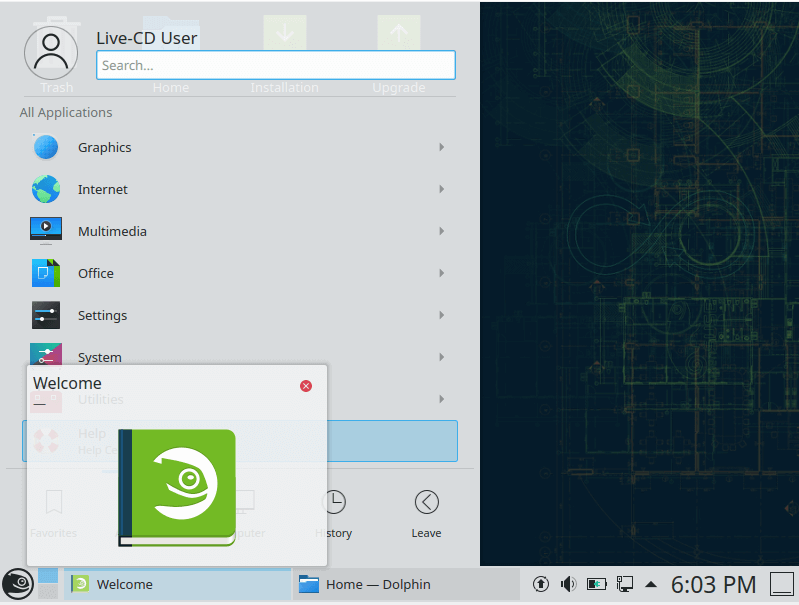
The DistroWatch listing names eleven desktop options — Cinnamon, Enlightenment, GNOME, IceWM, KDE Plasma, labwc, LXDE, LXQt, MATE, Wayfire, and Xfce — and you pick yours at install time rather than re-downloading a different ISO. KDE Plasma heads the list and remains the project’s flagship, but the breadth is the statement: from full Plasma down to IceWM, openSUSE will meet whatever hardware you have. Cinnamon fans will feel at home too — the desktop our Linux Mint review covers ships here as a first-class option, on an entirely different base.
The architecture list is equally generous: aarch64, armhf, i686, ppc64, ppc64el, s390x, and x86_64, with DistroWatch also filing the project under Raspberry Pi. In an era when mainstream distributions quietly drop everything but 64-bit x86, openSUSE still builds for mainframes and 32-bit ARM boards alike. The categories on the listing — Desktop, Server, Live Medium, Raspberry Pi, and Immutable — read like a mission statement: this is a distribution that intends to run everywhere.
The Immutable Corner: MicroOS and Aeon
That “Immutable” category points at the newest branch of the family: openSUSE MicroOS, a container-focused host with atomic updates, and Aeon, the immutable desktop built on the same ideas. Both lean on the snapshot-and-rollback machinery that Tumbleweed pioneered — transactional updates that either apply cleanly or roll back automatically. It is openSUSE’s answer to the same sealed-system trend Fedora is chasing with its Atomic spins, and it rounds out a lineup that now spans rolling, fixed, and immutable from a single project’s build infrastructure.
Who Should Try openSUSE?
openSUSE rewards users who want it all — and are willing to learn one project’s way of doing things:
AWS Alternative - Digital Ocean
- Rolling-release fans with scar tissue — Tumbleweed delivers current software with openQA gating and Snapper rollbacks, the safest way to live on the edge.
- Enterprise-curious desktop users — Leap 16.0’s SUSE Linux Enterprise base offers the fixed-release calm of a server distro with a desktop on top.
- KDE Plasma devotees — Plasma is the flagship desktop here, and openSUSE has shipped some of the most polished Plasma integrations in Linux.
- Tinkerers who like one control panel — YaST remains the most complete graphical administration tool any distribution ships.
- Owners of unusual hardware — seven architectures plus Raspberry Pi support means mainframes, POWER boxes, and 32-bit ARM boards are all welcome.
Conversely, minimalists who want the smallest possible base, or users who prefer Debian-style packaging, may be happier elsewhere — like Debian, openSUSE is proudly independent, but its RPM/Zypper world is a different country. And anyone who wants a single, opinionated desktop out of the box might find eleven choices to be ten too many.
Final Thoughts
openSUSE is the distribution for the user who refuses to pick a lane: rolling Tumbleweed snapshots gated by openQA, fixed Leap 16.0 releases on an enterprise base with support into 2032, Zypper and YaST tooling, eleven desktops, seven architectures, Btrfs snapshots on by default, and now immutable MicroOS and Aeon spins — all free, all from one independent German community project. Rank 14 on DistroWatch with 536 reader reviews suggests the word is out.
Few projects attempt this much breadth without collapsing under it. openSUSE has been at it since the 1990s, and the listing reads like a project confident in every one of its answers. If you have ever wished your rolling release came with seatbelts, or your stable release came with a newer desktop, this is the distribution built for exactly that complaint.
Source: DistroWatch openSUSE page (https://distrowatch.com/table.php?distribution=opensuse). Information cited in this post reflects the DistroWatch listing and release information for openSUSE (Tumbleweed snapshot dated June 17, 2026; Leap 16.0, released October 1, 2025).