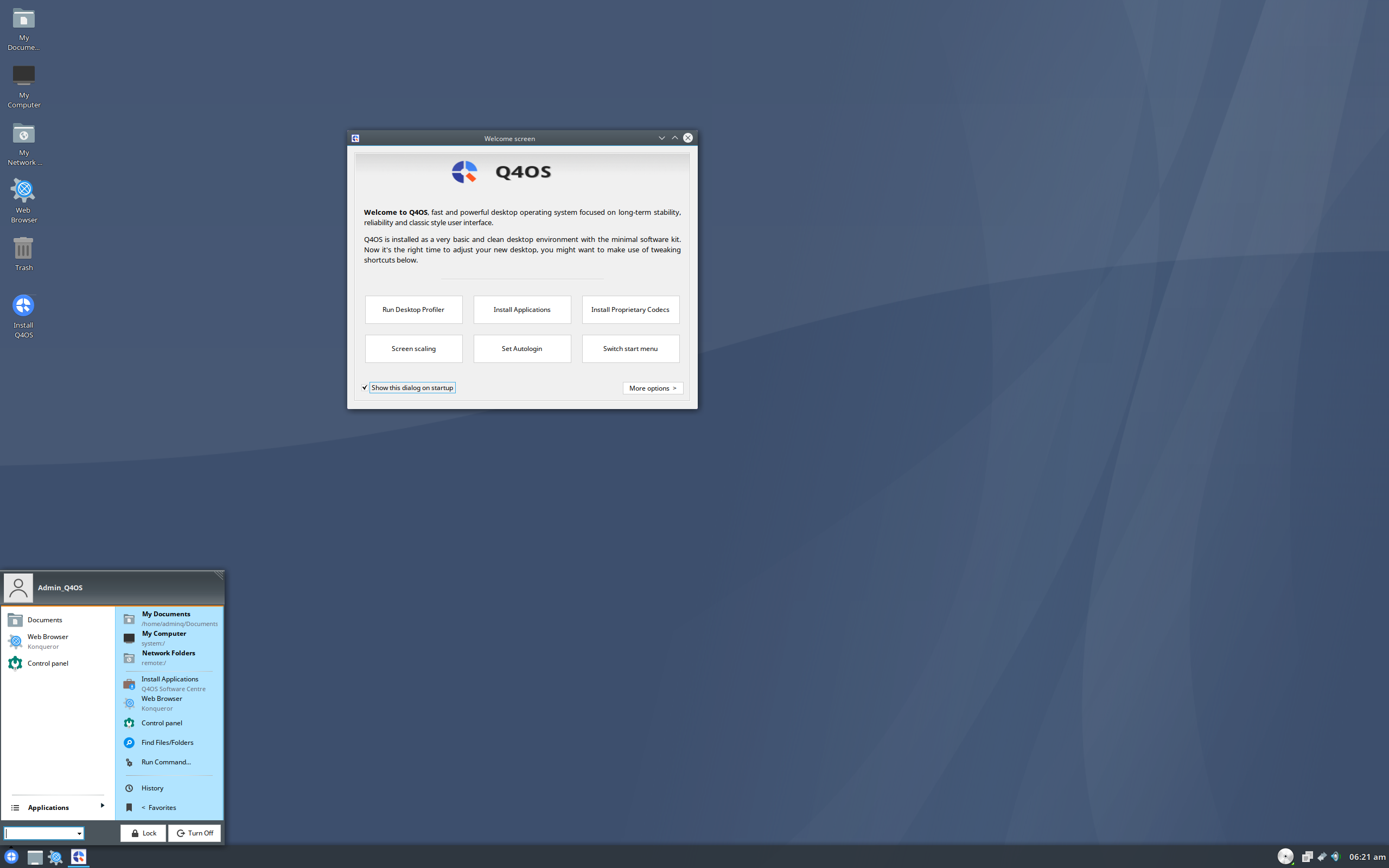
Q4OS Review
Q4OS 7.0-r5: The Debian-Based Desktop That Still Believes in Old Computers
Q4OS is a free, Debian (Stable)-based desktop Linux distribution from Czechia that pairs a classic Trinity desktop with a modern KDE Plasma option — and it is built to run fast on aging hardware. With version 7.0-r5 in testing and a rock-solid 6.9 release behind it, this is one of the most practical choices for reviving an old laptop.
Every year, perfectly good computers get retired because modern operating systems have outgrown them. Q4OS exists to push back against that. According to its DistroWatch listing, Q4OS is a Debian-based desktop Linux distribution offering a choice of a classic-style user interface (Trinity) and a modern desktop environment (KDE Plasma) — backed by the rock-solid Debian Stable base that system administrators have trusted for decades. If you want to understand what that base brings to the table, start with our Debian review before reading on.
What sets Q4OS apart is not just what it is, but who it is for. DistroWatch files it under the “Desktop”, “Live Medium”, and “Old Computers” categories, and the project’s own utilities — a Desktop Profiler, a Software Center, and installers for third-party applications — show a team thinking about real users rather than just real nerds. It currently sits at #23 on DistroWatch with 414 hits per day and an 8.8/10 average visitor rating from 202 reviews, respectable numbers for a project that deliberately avoids the spotlight.
At a Glance
| Base | Debian (Stable) |
| Current listed release | 7.0-r5 (testing), released September 8, 2026 |
| Stable releases | 6.9 (released September 16, 2026; EOL August 2030), 5.10 (EOL June 2028) |
| Desktops | KDE Plasma and Trinity |
| Architectures | i686, x86_64 (32-bit still supported) |
| DistroWatch categories | Desktop, Live Medium, Old Computers |
| Origin | Czechia |
| ISO image size | 1,700–2,200 MB |
| Price | Free |
| Status | Active |
Feature details and version information are based on the DistroWatch Q4OS listing, current as of September 2026.
Two Desktops, One Sensible Philosophy
Most distributions pick one desktop and ask you to like it. Q4OS gives you two genuinely different options: the classic-style Trinity interface for the old-school crowd, and a modern KDE Plasma environment for everyone else. Trinity will feel instantly familiar to anyone who used KDE 3 back in the day — taskbar, start-style menu, no surprises — while Plasma brings the full modern KDE experience with all its customization.
That choice is deliberate. The project knows its audience includes people migrating from Windows on older machines, and it does not force them to learn a new desktop paradigm on day one. If Plasma is what draws you in, our openSUSE review covers another strong Plasma-based option — but Q4OS pairs its desktops with a much lighter overall system footprint.
Reader reviews on DistroWatch back this up: users repeatedly praise the lightness, responsiveness, and stability of the system, with several reporting successful installations on decade-old laptops that other distributions left sluggish or unusable.
Built to Revive Aging Hardware
The “Old Computers” category on DistroWatch is not just a label here — it is the mission statement. Q4OS still supports i686 (32-bit) processors alongside x86_64, a rarity in 2026 when most distributions have dropped 32-bit entirely. That alone makes it one of the few current options for genuinely ancient machines.
The practical reports are compelling. DistroWatch reader reviews describe Q4OS running smoothly on Ivy Bridge and Haswell-era laptops, on an 11-year-old Dell XPS, and on refurbished Chromebooks — with full hardware detection and Flatpak support working out of the box. If squeezing life out of minimal hardware is your goal, our antiX review covers another Debian-based lightweight champion; Q4OS is the more beginner-friendly of the two.
And it does this without looking like a relic. The screenshots in the DistroWatch gallery show a clean, polished desktop — the project clearly believes limited resources should not mean an ugly or dated interface.
Debian Under the Hood, Q4OS Tools on Top
Underneath the desktops sits Debian Stable — which means access to Debian’s enormous software repositories, its legendary stability, and years of security support (the 6.9 release is supported through August 2030, and 5.10 through June 2028). For anyone who wants Debian’s reliability with a friendlier face, this is the same formula our MX Linux review praised in another form.
On top of that base, Q4OS ships its own utilities. The Desktop Profiler lets you switch the desktop’s look and behavior between profiles, the Software Center simplifies installing applications, and the project’s installers for third-party applications handle the proprietary software that Debian itself will not ship. It is a thoughtful layer: Debian’s foundation, minus Debian’s famous “figure it out yourself” attitude.
The project also offers unusual installation routes, including a Windows-based installer for trying Q4OS alongside an existing Windows setup — a low-commitment way for curious Windows users to test the waters.
Who Should Try Q4OS?
Q4OS is a purpose-built tool that happens to work well as a general desktop. It shines brightest for:
- Owners of aging hardware — old laptops, refurbished Chromebooks, and 32-bit machines that modern distributions have abandoned. The i686 support alone puts Q4OS on a very short list.
- Windows migrants who want a familiar classic-style desktop (Trinity) and a gentle learning curve, backed by Debian’s stability.
- Debian fans who want convenience — if you like Debian’s reliability but would rather not hand-configure everything, Q4OS adds the polish. Fans of the Debian family may also enjoy our MX Linux review for a different take on the same base.
- Tinkerers and refurbishers who restore old machines for friends, family, or charity and need something that “just works” on weak hardware.
- KDE traditionalists who miss the classic KDE 3 workflow and want it maintained on a modern, supported base.
On the other hand, Q4OS is not chasing the bleeding edge. If you want the newest kernels, the latest Plasma the week it drops, or a rolling-release thrill ride, look elsewhere. This is a distribution that values working tomorrow over shiny today.
Final Thoughts
Q4OS occupies a quiet but important corner of the Linux world. It is a free, actively developed, Debian (Stable)-based distribution from Czechia with two well-chosen desktops, real 32-bit support, and a genuine commitment to older computers — ranked #23 on DistroWatch with an 8.8/10 visitor rating that suggests its users are not just trying it, they are staying.
The version picture is healthy: 7.0-r5 in testing as of September 2026, a 6.9 stable release supported through 2030, and a 5.10 line maintained through 2028. That is the kind of long-term thinking that matches the project’s audience — people who keep computers for a decade, not a product cycle.
Bottom line: If you have an aging computer gathering dust, or you simply prefer a classic desktop on a rock-solid Debian base, Q4OS deserves a serious look. It is proof that “lightweight” and “polished” do not have to be opposites.
Source: DistroWatch Q4OS feature table. Information cited in this post reflects the DistroWatch listing for Q4OS, current as of September 2026, including version 7.0-r5 (testing, released September 8, 2026).