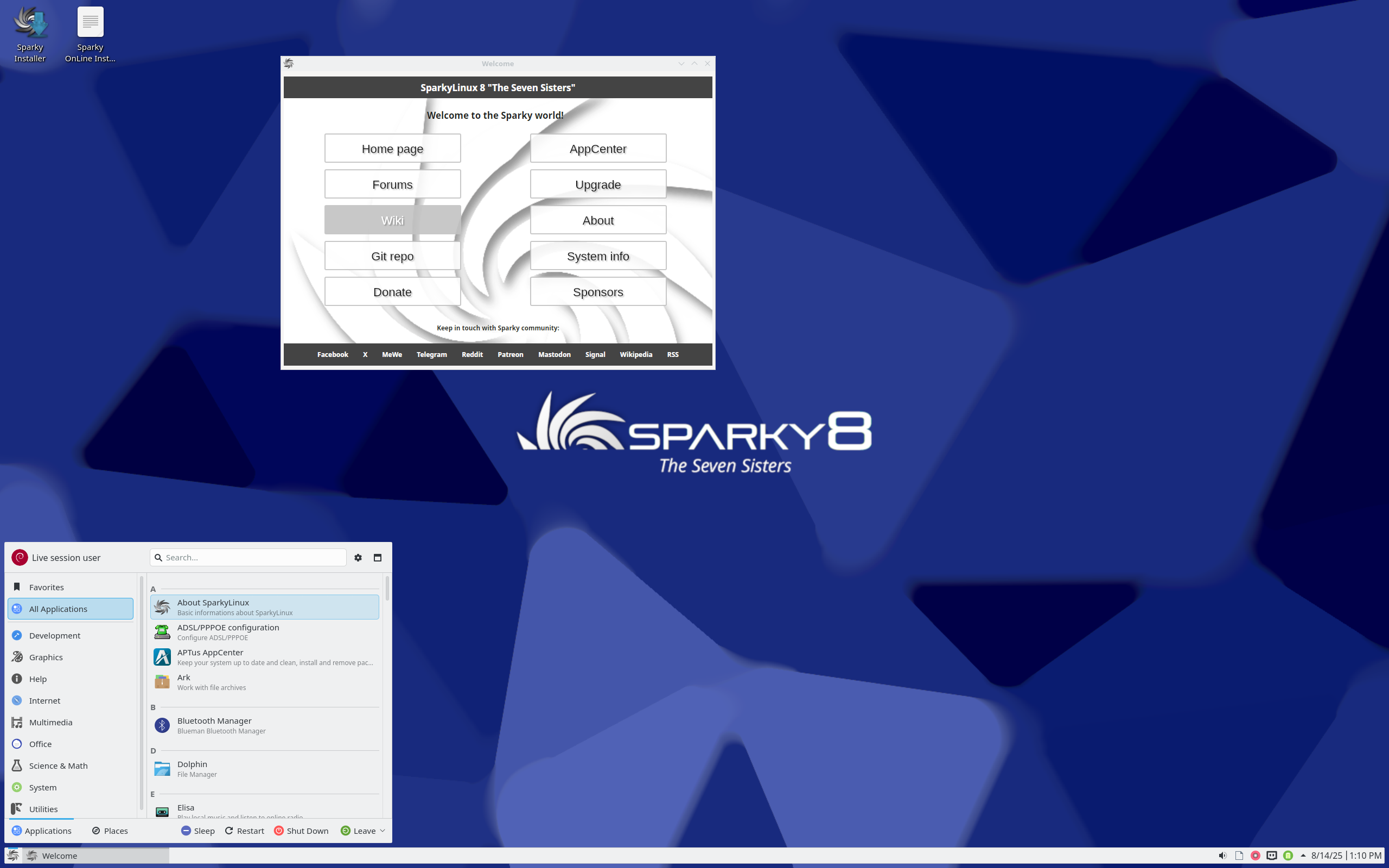
SparkyLinux Review
SparkyLinux 8.4: Poland’s Debian Remix for Every Desktop
Some distributions ask you to pick one desktop and live with it. SparkyLinux, a long-running project out of Poland, takes the opposite approach: it ships a whole family of Debian-based editions, each built around a different desktop environment, so you can match the desktop to your hardware instead of the other way around. The editions span KDE Plasma, LXQt, MATE, and Xfce, plus a lightweight flavor featuring the Openbox window manager — and DistroWatch’s listing now also names labwc among the supported desktops.
Sparky’s other signature move is that it comes in two flavors of freshness. There is a conservative variant based on Debian’s “Stable” branch for people who want their system to just keep working, and a more up-to-date one derived from Debian “Testing” for those who prefer newer software. That duality runs through the release history: DistroWatch announced SparkyLinux 8.4 — the latest point release in the stable line — on August 10, 2026, while the testing-based line rolls on with dated releases such as SparkyLinux 2026.03 from March 15, 2026.
The project earns genuine goodwill from the people who try it: the DistroWatch listing shows an average visitor rating of 8.3 out of 10 across 125 reviews, paired with a popularity rank of 46 at 263 hits per day. That is a strong combination — a broad menu of editions, two release temperaments, and a community that rates the experience highly. It is no surprise the project has been active and shipping since the Debian 7 era, with releases reaching all the way back to the early 2010s.
SparkyLinux 8.4 at a Glance
| Feature | SparkyLinux 8.4 |
| Release date | August 10, 2026 (per DistroWatch) |
| OS type | Linux |
| Based on | Debian (Stable), Debian (Testing) |
| Origin | Poland |
| Desktops | KDE Plasma, LXQt, MATE, Openbox, Xfce (plus labwc) |
| Architectures | i686, x86_64 |
| Category | Desktop, Live Medium |
| Status | Active |
| Package management | APT with DEB packages (via its Debian base) |
| DistroWatch popularity | Rank 46 (263 hits per day) |
| Average visitor rating | 8.3/10 from 125 reviews |
| Recent releases | 8.4 (Aug 2026), 2026.03 (Mar 2026), 8.2 (Feb 2026), 8.1 (Nov 2025) |
Two Variants: Conservative Stable or Fresh Testing
SparkyLinux’s most distinctive choice is not a desktop but a philosophy about how new software should reach you. The “Stable” variant is built on Debian Stable, the famously cautious foundation — ideal for workstations and anyone who values reliability above novelty. The “Semi-rolling” variant is derived from Debian Testing, tracking newer packages while still benefiting from Debian’s review pipeline. As DistroWatch’s official description puts it, the project “offers two variants of its products — a conservative one based on Debian’s ‘Stable’ branch, and a more up-to-date one derived from Debian ‘Testing’.”
This is a different answer than most Debian derivatives give. Where our MX Linux review describes a project that layers its own tools over Debian Stable, Sparky gives you the literal choice between Stable and Testing straight from the two branches, without pretending one pace suits everyone. If you have ever wished Debian itself came with a picker for “how fresh?”, SparkyLinux is that picker.
One Project, Six Desktops
Rather than anointing a single flagship desktop, SparkyLinux ships parallel editions: full-featured KDE Plasma for modern hardware, Xfce and MATE for the middle ground, the featherweight LXQt, and an Openbox edition for people who want their window manager to stay out of the way. The DistroWatch listing’s desktop roster — KDE Plasma, labwc, LXQt, MATE, Openbox, Xfce — is one of the broadest of any Debian-based distribution on the site, and every edition is offered as a live medium, so each desktop can be test-driven before installation.
That breadth makes Sparky a practical distro-hopping laboratory: you can evaluate how Plasma, MATE, Xfce, and LXQt feel on the same Debian foundation without changing distributions. Readers of our Debian review know the underlying system well — Sparky is essentially Debian repackaged for desktop life, with the desktop choice put front and center.
Refinance Your Student Loan At Sofi
Built for Trying, Not Just Installing
DistroWatch files SparkyLinux under “Desktop” and “Live Medium,” which captures how the project expects to be used: boot the live session, see if the edition fits your hardware and habits, then install if it does. The i686 architecture support is a notable holdout from an earlier era — older 32-bit machines can still get a modern, supported Debian-based desktop here — while x86_64 covers everything current. Past headlines on the listing note features like storage persistence on USB thumb drives, reinforcing the portable, try-it-anywhere spirit.
The ecosystem around the project is friendly and well-documented for its size: an official wiki, user forums, a bug tracker, and download mirrors are all linked from the DistroWatch page, and the project maintains a donate page rather than charging for anything. With an 8.3/10 visitor rating from 125 reviewers, the community’s experience backs up the feature list.
Who Should Try SparkyLinux?
- Debian fans who want the same foundation with a desktop-first edition system and a choice of release temperaments.
- Anyone on older hardware — the i686 support and the LXQt/Openbox editions keep aging machines useful.
- Desktop tinkerers who want to compare KDE Plasma, MATE, Xfce, and LXQt on one common base.
- Users torn between stability and freshness: the Stable and Testing variants let both camps stay in the same project.
- Fans of lightweight Debian-based systems who read our antiX review — Sparky’s Openbox and LXQt editions are a fuller-featured cousin worth a look.
- People who like trying before installing: every edition boots as a live medium.
Final Thoughts
SparkyLinux is what you get when a project refuses to choose for you — desktop, freshness, even 32-bit versus 64-bit are all presented as parallel editions rather than arguments. The Stable/Testing split is genuinely useful, the desktop spread covers everything from Plasma’s polish to Openbox’s minimalism, and the 8.3/10 visitor rating suggests the execution holds up. With releases landing steadily through 2026, this is a healthy, active project.
If you want the Debian family with maximum choice, grab an edition and boot the live session. And if you prefer your Debian polished into a single opinionated desktop, our Linux Mint review covers that end of the spectrum instead.
For release details, edition downloads, and reader reviews, see the SparkyLinux page at DistroWatch.