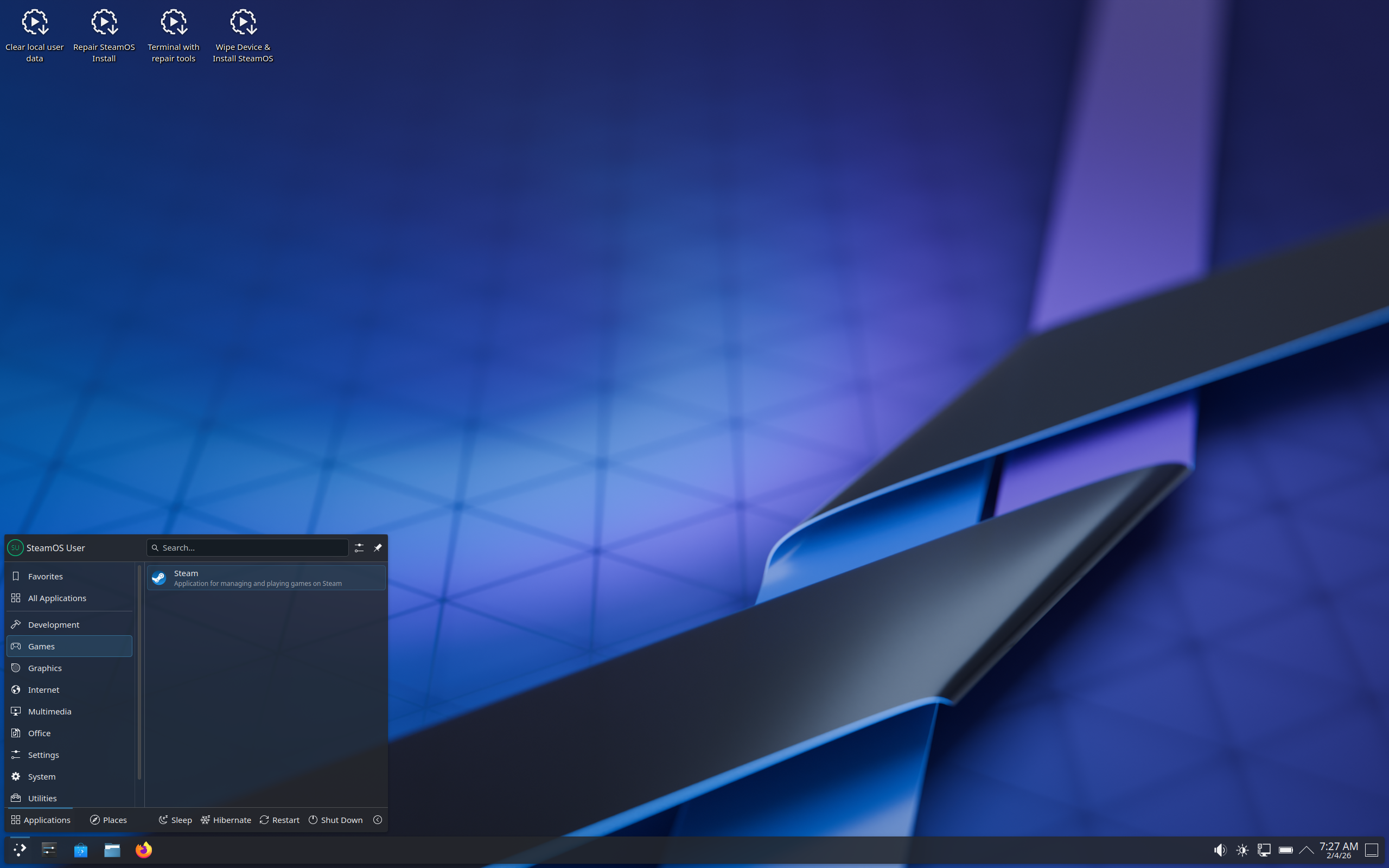
SteamOS Review
SteamOS 3.8.14: The Operating System That Made Linux Gaming a Household Word
Few distributions can claim to have changed what people think Linux is for. SteamOS can. DistroWatch lists it as an Arch-based, USA-origin distribution from Valve Corporation, carrying the Gaming category and an Active status. It ships with Steam, Valve’s own video game store, and serves as the default Linux distribution for Valve’s line of gaming hardware — the Steam Deck, the Steam Machine, and the Steam Frame — while also supporting third-party handhelds like the Lenovo Legion Go and ASUS ROG Ally and installing on standard personal computers.
The latest version tracked in DistroWatch’s comparison table is 3.8.14, released July 7, 2026, following 3.7.7 (May 22, 2025) and 3.5.7 (November 27, 2023). It is a free, fixed-release system for x86_64 hardware with KDE Plasma as the default desktop, pacman package management, and systemd. It ranks #56 in DistroWatch’s popularity chart (212 hits per day; #41 over the last three months), and visitors rate it 8.0 out of 10 across 2 reviews.
SteamOS is the rare distro whose audience found it before its philosophy did. Gamers don’t install it to learn Linux — they install it to play games, and the console-grade experience is what keeps them. If the Arch foundation appeals to you in a more desktop-first package, see our Arch review; for a gaming-first take from the community side, our Bazzite review covers the closest spiritual relative.
SteamOS at a Glance
| Latest release | 3.8.14 (released July 7, 2026, per DistroWatch) |
| Base | Arch |
| Origin / Status | USA / Active |
| Category | Gaming |
| Release model | Fixed |
| Default desktop | KDE Plasma |
| Package management | pacman |
| Installer | Text mode |
| Init system | systemd |
| Architecture | x86_64 (64-bit only) |
| Image size | 3,200–3,300 MB |
| Default browser | Firefox |
| Cost | Free |
| DistroWatch popularity | #56 (~212 hits per day; #41 over the last 3 months) |
| Visitor rating | 8.0/10 from 2 reviews |
From Debian Roots to Arch Wings
Longtime followers will remember a different SteamOS. DistroWatch’s older table columns tell the story: the 2.x era (2.117 through 2.195, released between 2017 and 2019) was Debian-based, used apt, and shipped a GNOME desktop — the distribution Valve built for its first wave of living-room Steam Machines. That line has since given way to the new generation: versions 3.5.7, 3.7.7, and now 3.8.14 are Arch-based with pacman and KDE Plasma, the system that shipped on the Steam Deck.
The lineage is visible in a single glance at the comparison table. The package columns change completely between 2.195 and 3.5.7 — apt gives way to pacman, GNOME to KDE Plasma — while the project kept its identity: free, x86_64, systemd, and resolutely focused on one job. If the Arch-under-the-hood part makes you want the full do-it-yourself Arch experience instead, CachyOS is another Arch-based option built for performance — but SteamOS is the one tuned by the company that sells the hardware.
Game Mode First, Desktop Second
SteamOS’s defining design decision is the split personality. The primary experience is the console-style interface built around Steam — the store, the library, and the overlay — with the system tuned so games launch, suspend, and resume the way console players expect. The KDE Plasma desktop is there as a full-featured second mode: a regular Linux desktop where you can run ordinary applications, browse with Firefox, and manage files like any other system.
That dual nature is why the distribution’s hardware story matters so much. On Valve’s own devices — Steam Deck, Steam Machine, Steam Frame — SteamOS is the native operating system, with drivers and the graphics stack matched to the hardware. DistroWatch’s description notes it also runs on supported third-party handhelds such as the Lenovo Legion Go and ASUS ROG Ally, and can be installed on standard PCs. It’s a rare case of a Linux distribution where the hardware target is the feature list.
KDE Plasma, Console-Tuned
The current releases put KDE Plasma front and center as the default user interface — a notable shift from the GNOME desktop of the Debian era. Plasma is a strong choice for this role: it’s flexible, polished, and familiar enough for converts arriving from Windows, which is exactly the audience SteamOS courts.
AWS Alternative - Digital Ocean
If you like Plasma but want it in a conventional desktop distribution rather than a gaming one, it’s worth a look at our KDE neon review — both put KDE Plasma front and center, but SteamOS subordinates the desktop to the game library while neon treats the desktop itself as the star.
An Arch Base You Never Have to See
Under the hood, the 3.x line is Arch-based with pacman as the package manager, and DistroWatch lists a Fixed release model — no rolling updates to manage, no upgrade cliff to plan around. The release history (3.5.7 in November 2023, 3.7.7 in May 2025, 3.8.14 in July 2026) shows a cadence of polished, periodic updates rather than a constant stream of changes.
For most users, the Arch heritage is invisible — and that’s the point. Where Arch itself expects you to assemble the system by hand, SteamOS uses the Arch base as a foundation for something pre-built and appliance-like: install, sign in to Steam, play. The x86_64-only architecture and roughly 3.2 GB image keep the target narrow and the experience consistent.
Who Should Try SteamOS?
- Steam Deck owners — it’s the native operating system, and the reason the Deck feels like a console rather than a small PC.
- Handheld PC gamers with a Lenovo Legion Go, ASUS ROG Ally, or similar device who want a game-first interface instead of Windows.
- Linux gamers who want the Steam experience with the desktop available as a fallback rather than the main event.
- Living-room PC users building a Steam Machine-style setup where the TV interface matters more than a traditional desktop.
- KDE Plasma fans curious about the desktop running in service of gaming rather than general computing.
- The Arch-curious but cautious — an Arch base with a fixed release model and no assembly required.
Final Thoughts
SteamOS is the distribution that proved a Linux system can sell on experience rather than ideology. It’s free, active, climbing DistroWatch’s popularity chart (#41 over the last three months), and rated 8.0/10 by the community — backed by a company that ships the hardware it runs on. The Arch base, KDE Plasma desktop, and fixed release cadence make the 3.x generation the most approachable version of Valve’s vision yet. For a community-built alternative with the same gaming-first philosophy, compare notes with our Bazzite review — but if you own a Steam Deck, you’re already running the answer.
For release details, package versions, and the full version history, see the SteamOS page at DistroWatch (comparison table last updated July 10, 2026).