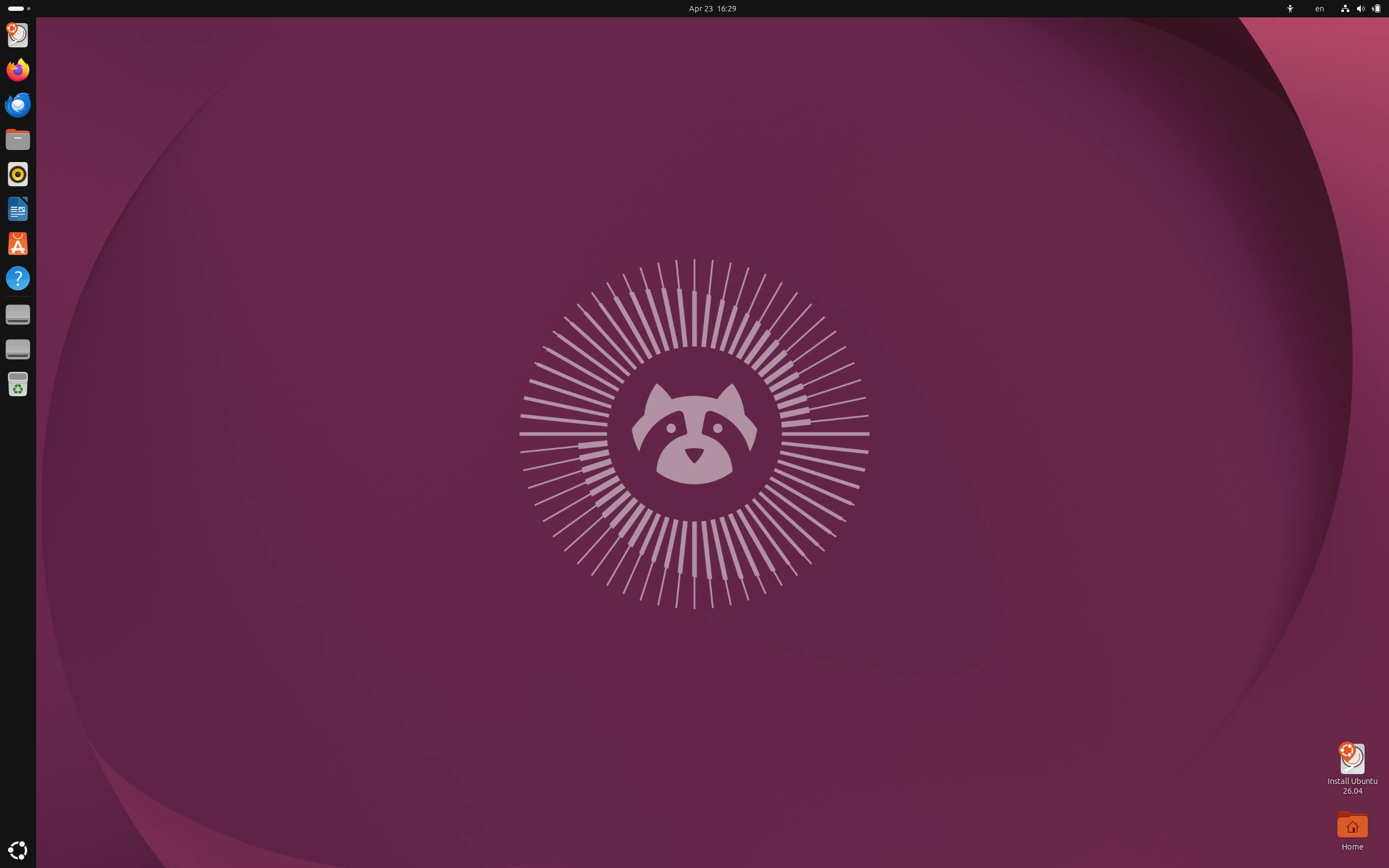
Ubuntu Review
Ubuntu 26.04 LTS “Resolute”: The Debian-Based Distribution That Made Desktop Linux Mainstream
The most recognized name in Linux, Ubuntu pairs a Debian foundation with a polished GNOME desktop, LTS stability, and both community and professional support. Here’s what the DistroWatch listing says about the current long-term-support release.
If Linux has a flagship, it is Ubuntu. According to its DistroWatch listing, Ubuntu is a Debian-based distribution — originally from the Isle of Man — that describes itself as “a complete desktop Linux operating system, freely available with both community and professional support.” The name comes from an ancient African word meaning “humanity to others,” and the distribution’s manifesto commits to software that is free of charge, usable in people’s own languages, and freely customizable.
The release currently listed by DistroWatch is Ubuntu 26.04 LTS “Resolute”, released on April 23, 2026, with a first point release (26.04.1) following on August 28, 2026. It is a fixed-release distribution with support running through April 2031 — the long support window that defines Ubuntu’s LTS line. It sits at rank 8 on DistroWatch’s popularity chart (about 924 hits per day), with an average visitor rating of 7.8 out of 10 from 403 reviews.
Ubuntu is free to download as an ISO (roughly 1.2 GB to 6.3 GB depending on the edition). The DistroWatch feature table names GNOME as the default desktop, Firefox as the default browser, LibreOffice as the office suite, and APT with deb and Snap packages as the software model. Readers coming from our Debian review will recognize the family tree — but Ubuntu’s whole pitch is what Debian’s foundation becomes when it is polished for the mainstream desktop.
At a Glance
| Feature | What Ubuntu 26.04 LTS Offers |
|---|---|
| Current listed release | Ubuntu 26.04 LTS “Resolute”, released April 23, 2026 (26.04.1 point release August 28, 2026) |
| Distribution base | Debian |
| Release model | Fixed release, LTS line supported through April 2031 |
| Default desktop | GNOME (the listing also references Unity) |
| Package management | APT; deb and Snap package formats |
| Installer | Ubuntu Desktop Bootstrap |
| Default browser | Firefox |
| Included office suite | LibreOffice |
| Supported architectures | amd64, aarch64, ppc64el, riscv, s390x |
| Init system | systemd |
| Listed journaled file systems | Btrfs, ext4, JFS, ReiserFS, XFS, ZFS |
| Typical ISO size | Approximately 1.2 GB to 6.3 GB |
| Multilingual | Yes |
| Price | Free |
Feature details and version information are based on the DistroWatch Ubuntu listing for release 26.04 LTS.
The LTS Rhythm: Predictability With Interim Bursts
Ubuntu’s release cadence is the most influential pattern in desktop Linux: a long-term-support release every two years, with interim releases in between for those who want newer software. DistroWatch lists 25.10 “Questing” (October 9, 2025) as the recent interim release and 26.04 LTS “Resolute” as the current LTS, backed by the point-release discipline — 26.04.1 landed August 28, 2026 — that makes LTS installs a safe bet for years at a time.
That predictability is the whole point. A fixed release means software versions stay stable through the support window — April 2031 for 26.04 LTS — instead of shifting under you. It is the same philosophy that makes Linux Mint (itself Ubuntu-based) so popular with switchers, but here you get it from the source, plus the official option of professional support through Canonical — something few community distributions can offer.
Note the DistroWatch listing also tracks a “snapshot” build dated September 14, 2026 — a rolling development snapshot of what will become the next release — but for a production machine, the 26.04 LTS line is the one the listing’s release dates, support window, and ratings are built around.
GNOME, Snaps, and the Out-of-Box Desktop
Ubuntu ships GNOME as its default desktop, paired with Firefox and LibreOffice — a complete working system the moment installation finishes. The DistroWatch listing confirms the installer is the Ubuntu Desktop Bootstrap, and the distribution is marked multilingual, so setup in your own language is the norm, not an afterthought.
Software comes through APT with deb packages plus Snap, Ubuntu’s sandboxed format. That pairing gives you Debian’s deep, trusted package archive alongside self-contained applications that update independently of the base system — a compromise between the fix-it-yourself flexibility of the parent distribution and the comfort-first curation of beginner distros like Zorin OS, another Ubuntu-based option for first-time switchers.
Underneath, the listing shows familiar mainstream plumbing: systemd as the init system and a choice of journaled file systems including ext4, Btrfs, and ZFS. The feature table lists architectures from standard 64-bit PCs (amd64) all the way to aarch64, ppc64el, riscv, and s390x — reflecting Ubuntu’s reach far beyond the desktop, into the server and immutable/server categories DistroWatch also assigns it.
More Than a Desktop: Server, Immutable, and Live Medium
DistroWatch categorizes Ubuntu as Beginners, Desktop, Immutable, Server, and Live Medium — five labels that explain why it shows up everywhere. The server pedigree is the quiet superpower: when a Ubuntu LTS supports both your laptop and your server through 2031, skills and configurations transfer directly between them. That server-desktop continuity is something Pop!_OS, another Ubuntu-based desktop distro, inherits for free — but Ubuntu remains the one with the server ecosystem behind it.
The “Immutable” and “Live Medium” categories round out the picture: a live ISO for testing before you commit, and immutable options for users who want a tamper-resistant, rollback-friendly system. And because Ubuntu is the reference platform so many projects target first, software availability is simply larger here than on most distributions — deb packages, Snaps, and the vast majority of Linux documentation assume an Ubuntu-like system.
Who Should Try Ubuntu?
Ubuntu is an unusually broad recommendation, but it fits some users especially well:
- First-time Linux users who want the distribution with the most tutorials, the largest community, and the smoothest beginner documentation — DistroWatch’s “Beginners” category exists for distros like this one.
- Anyone who values stability with a deadline — the 26.04 LTS line is supported through April 2031, so you install once and forget about major upgrades for five years.
- Users who might need professional support later — Ubuntu’s listing explicitly mentions professional support, a rare option if a hobby machine ever becomes a business machine.
- People running both desktop and server who want the same distribution, the same package manager, and the same long support window on both.
- Developers and IT staff who want the reference platform — the distro most third-party software, drivers, and cloud tooling target first.
Conversely, bleeding-edge enthusiasts who want the newest packages the day they land will find the fixed LTS model deliberately conservative — and longtime Ubuntu users sometimes explore Mint’s take on the Cinnamon desktop for a different flavor on the same base. But for the broad middle of Linux users, Ubuntu remains the default answer for a reason.
Final Thoughts
Ubuntu 26.04 LTS “Resolute” is not exciting in the way a brand-new distribution is exciting — and that is precisely its value proposition. It is Debian-based, free, fixed-release, supported through April 2031, and ships GNOME, Firefox, LibreOffice, APT with Snap, and a server-grade ecosystem under a beginner-friendly surface. The 7.8/10 visitor rating across 403 reviews suggests a large, opinionated user base — nobody rates a distribution that many times without having strong feelings, most of them good.
If you only ever install one Linux distribution, Ubuntu is the safe recommendation: the flagship name, the deepest documentation, the five-year LTS promise, and the option of professional support. Start with the 26.04 LTS line, and you will see exactly why so many distributions — Linux Mint among them — choose Ubuntu as their own foundation.
Source: DistroWatch Ubuntu page (https://distrowatch.com/table.php?distribution=ubuntu). Information cited in this post reflects the DistroWatch listing and release information for Ubuntu 26.04 LTS, released April 23, 2026.