Void Review
Void Linux 20250202: Independence Is the Whole Point
Most Linux distributions are remixes: take a Debian base, add a desktop, ship an installer, done. Void Linux isn’t a remix of anything. According to its DistroWatch listing, Void is an “independently-developed, general-purpose operating system based on the monolithic Linux kernel,” built from the ground up by its own community. That independence shapes every choice the distro makes — from its home-grown package manager to its rejection of systemd.
The current snapshot, Void 20250202 (released 2025-02-02 per DistroWatch), is the latest in a line of live-image releases for a distribution that is, at its core, rolling: daily updates keep the system current without ever needing a version upgrade. If you like the always-fresh feel of a rolling model — the same philosophy we covered in our Arch review — Void delivers it with a distinctly different personality.
It’s also worth knowing what Void is not: it is not a hand-holding, click-through-everything desktop. The installer runs in text mode, the default live image ships with the lightweight Xfce desktop, and much of the power sits at the command line. That makes it a natural fit for tinkerers — much like our EndeavourOS review appealed to users who want a friendly entry point to an Arch-style rolling system, while Void appeals to those who’d rather learn the plumbing themselves.
At a Glance
| Fact | Detail (per DistroWatch) |
|---|---|
| Latest release | Void 20250202 (2025-02-02) |
| Based on | Independent (built from scratch) |
| Origin | Spain |
| Release model | Rolling, with daily updates |
| Default desktop | Xfce |
| Init system | runit (native) |
| Package manager | XBPS (binary + source) |
| Package format | xbps |
| Architectures | aarch64, armv6l, armv7l, i686, x86_64 |
| Filesystems | Btrfs, ext4, XFS |
| Installer | Text mode |
| Default browser | Firefox |
| Price | Free |
| DistroWatch rank | 22 (462 hits/day) |
XBPS: A Package Manager With Two Gears
Void’s standout feature is XBPS, the X Binary Package System. DistroWatch describes it as a hybrid binary/source package manager: users can quickly install, update, and remove prebuilt binary software, or build packages directly from source using the XBPS source packages collection. That dual approach is unusual — most distros force you into one world or the other, whereas Void lets you flip between convenience and control on a per-package basis.
In practice, the binary side is fast and clean. The XBPS tools are written to be quick, the repository is well-maintained, and the source-build side means even obscure or niche software can be compiled into a proper package rather than hand-installed outside the package database. It’s one of the genuinely distinct engineering choices in the distro landscape, and it works.
Get An Easy Personal Loan At Sofi
runit Instead of systemd
Void is one of the most prominent mainstream-leaning distributions that doesn’t use systemd at all. Its native init system is called runit — a small, simple, service-oriented init. This isn’t an anti-systemd gimmick; it’s a design preference baked into the distro from day one. Fans of the systemd-free philosophy may also want to read the Artix review — another distro that puts runit front and center — but Void got there on its own terms, as part of its independent codebase rather than as a fork of something else.
Rolling Release, Daily Updates, Real-World Freshness
DistroWatch lists Void’s release model as rolling with daily updates, and the package table backs it up: the current tree ships recent kernels, current toolchains, and fresh desktop packages. You install once and keep updating forever — no six-month or two-year upgrade leaps.
That carefulness is part of why it sits comfortably in DistroWatch’s top 25, recently climbing as high as rank 16 over a four-week window (568 hits per day) — the same kind of momentum we noted in the CachyOS review, another rolling distro that won users over with speed and freshness.
Lightweight by Design: Xfce and ARM Support
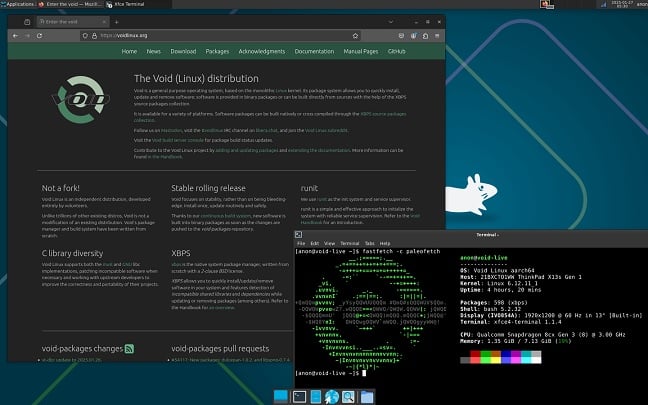
The default live image pairs Void’s minimal base with Xfce — a fast, uncluttered desktop that stays out of the way and runs well on modest hardware. Combined with a base install that avoids bloat, the result is a system that feels snappy even on older machines. Image sizes range from about 400 MB to 1.4 GB depending on the flavor.
Notably, Void officially supports Raspberry Pi hardware (both armv6 and armv7 per its DistroWatch description), alongside aarch64, i686, and x86_64. That broad architecture coverage makes it a strong candidate for everything from a single-board project to a daily-driver workstation — and the rolling model means your ARM install stays as fresh as your desktop one.
Who Should Try Void?
- Systemd skeptics and runit fans — if you want a modern desktop that boots with runit and stays that way, Void is the flagship option.
- Command-line learners — the text-mode installer and DIY ethos make it a great teacher for how Linux actually fits together.
- Rolling-release enthusiasts — daily updates and never reinstalling will feel familiar and welcome.
- Low-spec and ARM hardware owners — the Xfce default and Raspberry Pi support keep older and small devices useful.
- Distro hopers seeking something genuinely different — independent base, unique package manager, no systemd: this isn’t another remix.
Final Thoughts
Void Linux earns its place in any serious distro collection. It’s independent without being eccentric, rolling without being reckless, and minimal without being barren. The XBPS package manager and runit init give it a technical identity you won’t find anywhere else, while the Xfce desktop and broad hardware support keep it practical. If you’ve been curious about life outside the Debian/Arch/Red Hat triangle, Void is one of the most rewarding exits.
Sources: facts and release information from the DistroWatch page for Void (latest release Void 20250202, 2025-02-02), including its description, package table, and popularity ranking.