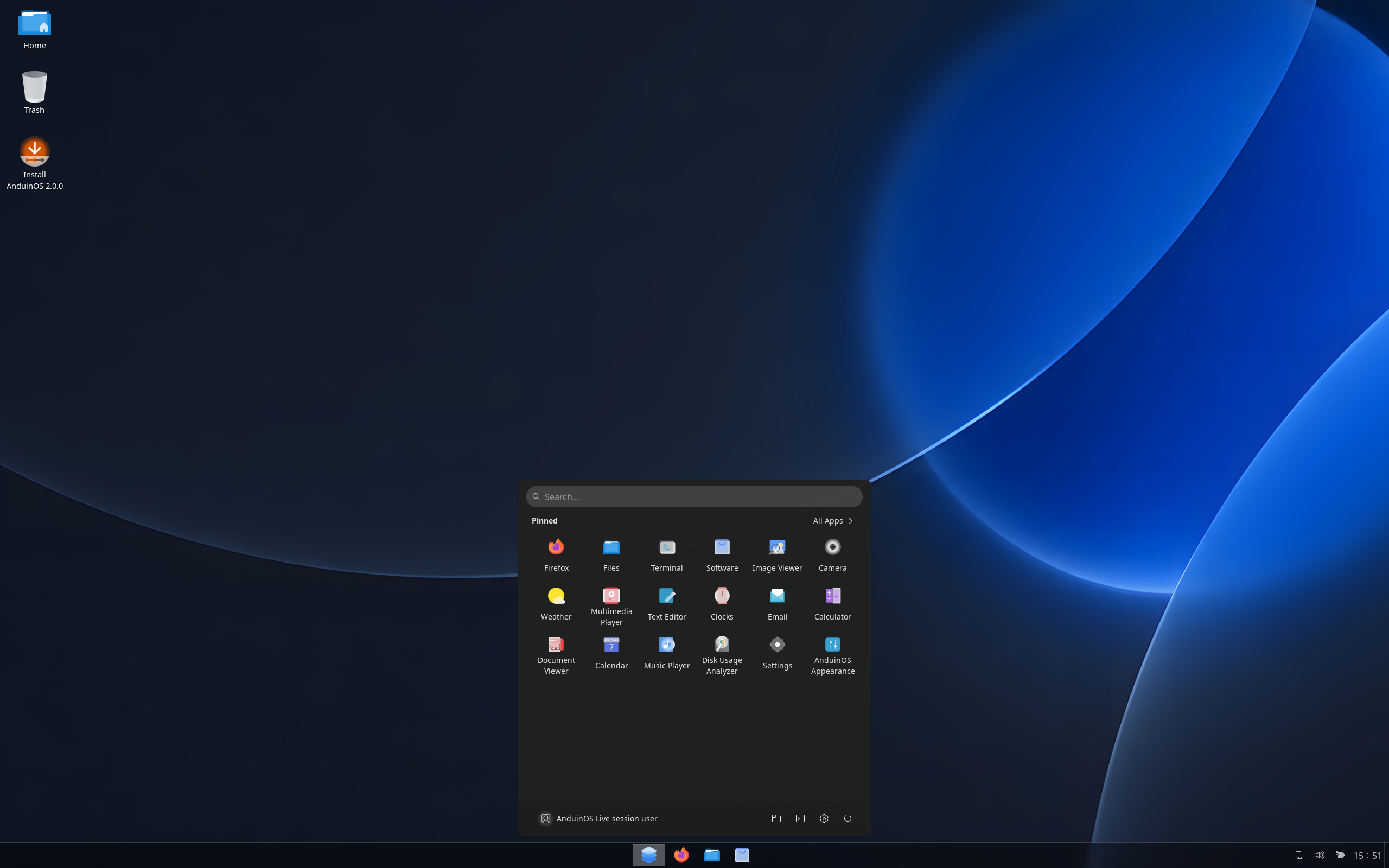
AnduinOS Review
AnduinOS 2.0.2: The Ubuntu-Based Distribution That Dresses GNOME Up Like Windows 11
AnduinOS takes Ubuntu’s solid base, removes Snap, themes GNOME to look like Windows 11, and ships smaller per-language ISOs. Here is what the DistroWatch listing says about the current release.
The fastest way to understand AnduinOS is to read its DistroWatch description in full: “AnduinOS is an Ubuntu-based distribution which provides a GNOME desktop which has been themed and styled to resemble Windows 11. The project provides a smaller ISO file than its parent with each supported language split into a separate ISO. Snap support, which is included in Ubuntu, has been removed from AnduinOS.” That single paragraph is the whole pitch — Ubuntu underneath, a familiar Windows-style face on top, and a deliberate decision to drop the one Ubuntu feature many users dislike most.
The release currently listed by DistroWatch is AnduinOS 2.0.2, released on August 20, 2026 — a point release on the 2.0 line, which DistroWatch news headlines say was announced on June 28, 2026. It is a fixed-release distribution, free to download, sitting at rank 13 on DistroWatch’s popularity chart (about 618 hits per day over the last six months), with an average visitor rating of 8.9 out of 10 from 43 reviews — an unusually high score for a young distribution. Since it is built on Ubuntu (and thereby Debian), readers of our Ubuntu review will feel immediately at home in its package ecosystem.
At a Glance
| Feature | What AnduinOS 2.0.2 Offers |
|---|---|
| Current listed release | AnduinOS 2.0.2, released August 20, 2026 (2.0.0 announced June 28, 2026) |
| Distribution base | Debian, Ubuntu |
| Release model | Fixed release |
| Default desktop | GNOME, themed and styled to resemble Windows 11 |
| Package management | apt; deb and Flatpak package formats (Snap support removed) |
| Installer | Ubiquity |
| Supported architectures | x86_64 |
| Init system | systemd |
| Listed journaled file systems | Btrfs, ext4 |
| ISO approach | Smaller ISO than its parent, with each supported language split into a separate ISO |
| Price | Free |
| DistroWatch popularity | Rank 13 (about 618 hits per day, 6-month figure) |
| Visitor rating | 8.9 out of 10 from 43 reviews |
Feature details and version information are based on the DistroWatch AnduinOS listing (table page last updated September 4, 2026).
A GNOME Desktop That Thinks It’s Windows 11
AnduinOS’s defining move is cosmetic, and it is entirely deliberate. The DistroWatch listing confirms the default desktop is GNOME, themed and styled to resemble Windows 11 — the one feature that distinguishes AnduinOS from the dozens of other Ubuntu derivatives. A Windows user sitting down in front of AnduinOS finds the layout they already know, which removes the single biggest source of friction in switching operating systems.
That switcher-friendly angle puts AnduinOS in the same conversation as Zorin OS’s take on a Windows-familiar desktop, another GNOME-based option built for people leaving Windows. Where Zorin leans on its own desktop layouts, AnduinOS stays closer to stock GNOME under the theme — meaning the look is Windows, but the plumbing is mainstream GNOME, with all the documentation and extensions that implies.
Ubuntu Underneath, Minus the Snaps
Under the Windows-like surface, AnduinOS is straightforward Ubuntu machinery: the listing names apt as the package manager with deb and Flatpak formats, and explicitly notes that Snap support — included in Ubuntu — has been removed. That is a bigger deal than it sounds: it means the distribution ships without snapd running in the background, and desktop applications arrive via Flatpak instead. Readers familiar with Mint’s snap-free approach will recognize the philosophy — trust the deb archive for the system, use Flatpak for apps.
The rest of the foundation is conventional and solid: systemd as the init system, the Ubiquity installer inherited from Ubuntu, x86_64 as the sole listed architecture, and a choice of Btrfs or ext4 journaled file systems. It is a fixed-release distribution that tracks Ubuntu’s cadence closely, so every new Ubuntu release brings a matching AnduinOS release not long after.
Small ISOs, One Per Language
The DistroWatch description highlights something few distributions bother with: AnduinOS provides a smaller ISO file than its parent, with each supported language split into a separate ISO. Instead of one bloated image carrying every locale, you download only the image for your language — a leaner download and a leaner install. It is a small logistical choice that says a lot about the project’s priorities: less bloat, more focus.
Combined with the snap-free base, the result is a distribution that starts life lighter than Ubuntu itself. For users on modest bandwidth or older hardware, downloading a trimmed, language-specific ISO instead of a multi-gigabyte universal image is a genuinely welcome touch — and one the DistroWatch listing considers distinctive enough to lead with.
From 1.0 to 2.0: A Fast-Moving Young Project
The version history on the DistroWatch table tells the story of a project shipping steadily: 1.0.7 in March 2025, then 1.1.12, 1.2.6, 1.3.9, and 1.4.2 in January 2026, followed by the 2.0 line — 2.0.0 announced June 28, 2026 and 2.0.2 on August 20, 2026. Five minor lines of point releases in about eighteen months is a brisk cadence for a distribution maintained by a small team, and it mirrors the project’s stated commitment to keep pace with Ubuntu’s release cycle.
That pace seems to be paying off with users: the 8.9-out-of-10 average rating across 43 DistroWatch reviews is one of the strongest scores in the database. And because the base is Ubuntu and ultimately Debian — see our Debian review for the family tree — that high rating rests on one of the most tested software foundations in Linux.
Who Should Try AnduinOS?
AnduinOS has a clear target audience, but it fits a few others too:
- Windows 10 or 11 users curious about Linux who want the transition to feel familiar — the Windows-11-styled GNOME desktop is the whole point of this distribution.
- Beginners who want Ubuntu’s software base without wrestling with Snap quirks — apt, deb packages, and Flatpak apps cover everything a new user needs.
- Anyone annoyed by Snap — AnduinOS removes it entirely, which is rarer among Ubuntu derivatives than it should be.
- Users on modest bandwidth who appreciate the smaller, per-language ISOs instead of one giant universal download.
- Fans of fixed releases who prefer versioned releases that track Ubuntu’s cadence over rolling-release churn.
Conversely, users who need architectures beyond 64-bit PCs, who want a rolling-release model, or who prefer a distribution with a large established community should look elsewhere. AnduinOS is a young, focused project with a single developer behind it — pick it for the experience it is designed around, not as a general-purpose workhorse.
Final Thoughts
AnduinOS 2.0.2 knows exactly what it is: Ubuntu’s engine, GNOME’s toolkit, and a Windows 11 face, minus the Snap layer and minus the ISO bloat. The DistroWatch listing backs it up at every turn — the description, the 2.0.2 release date of August 20, 2026, the apt-plus-Flatpak package model, the per-language ISOs, and the rank-13 popularity with an 8.9/10 visitor rating that few distributions of any age can match.
If you are coming from Windows and want Linux to feel like home from the first boot, AnduinOS is one of the most purpose-built answers available — built on the Debian and Ubuntu foundation that half the Linux world already trusts, and rated 8.9 out of 10 by the people actually using it.
Source: DistroWatch AnduinOS page (https://distrowatch.com/table.php?distribution=anduin). Information cited in this post reflects the DistroWatch listing and release information for AnduinOS 2.0.2, released August 20, 2026.